American Lobster Facts: Biology of Nova Scotia's Lobster
American lobster facts from DFO and NOAA: range, anatomy, moulting, lifespan, breeding, diet, rare colours, record size and climate change off Nova Scotia.
By NovaShell Editorial Team · · 12 min read
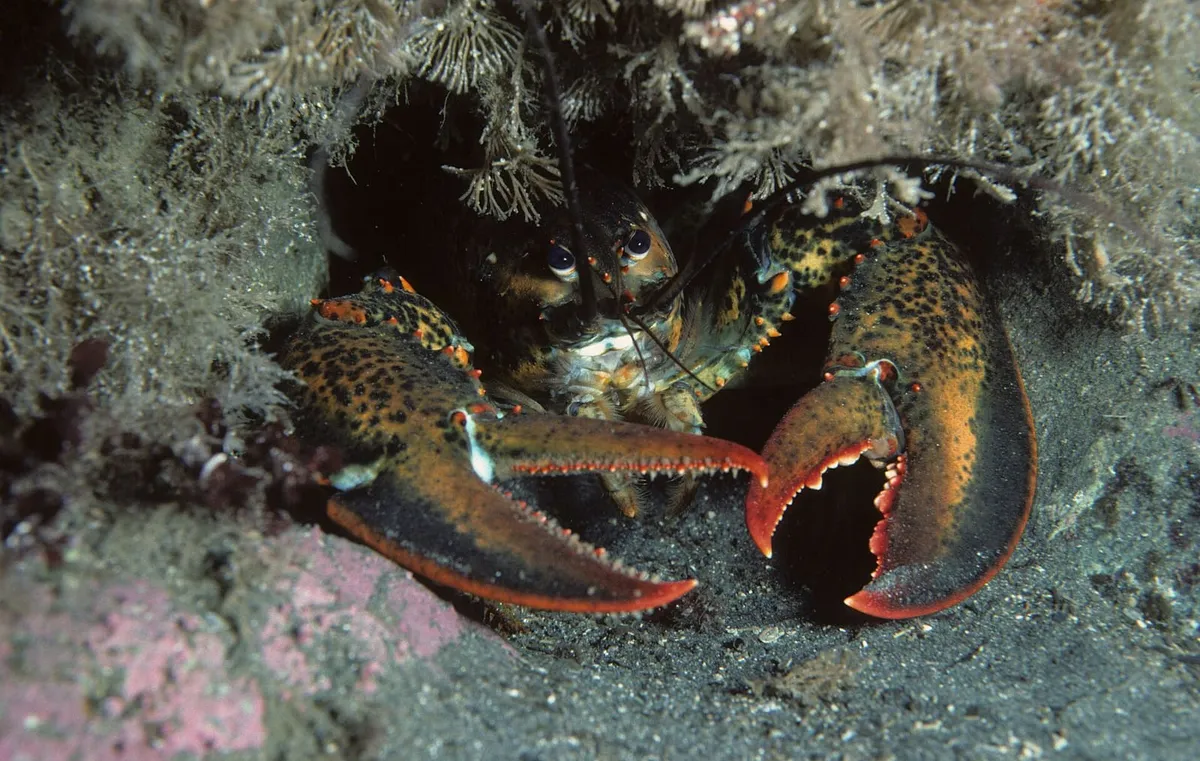
The American lobster (Homarus americanus) is the only lobster species in Canadian waters. It’s a ten-legged crustacean that lives on the sea floor from Labrador to the U.S. mid-Atlantic coast, and it’s abundant off southwest Nova Scotia and along the Gulf of St. Lawrence shores of the Maritimes. In Nova Scotia, it takes about 8 to 10 years to reach the legal size of 82.5 mm carapace length, about 0.45 kg (1 lb), according to Fisheries and Oceans Canada (DFO). It may live 50 years or more. The heaviest ever recorded, 20.14 kg, was caught off Nova Scotia in 1977.
Below are the key American lobster facts, drawn mostly from DFO and NOAA Fisheries: how the lobster is built, how it grows by moulting, how females carry their eggs, what lobsters eat, why a few are blue, and what warming water means for Nova Scotia’s most valuable fishery. For the fishery itself, start with Nova Scotia lobster: the complete guide. More biology articles are on the lobster biology topic hub.
American lobster facts at a glance
| Fact | Detail | Source |
|---|---|---|
| Scientific name | Homarus americanus | DFO, NOAA |
| French name | Homard (the clawed lobster genus) | The Canadian Encyclopedia |
| Range | Labrador to North Carolina (Cape Hatteras) | NOAA, The Canadian Encyclopedia |
| Habitat | Sea floor, from mud and sand to cobble and boulders | DFO |
| Water temperature | Juveniles and adults: below 0°C to about 25°C | DFO |
| Legs | 10, including two large claws | NOAA |
| Time to legal size (Maritimes) | About 8–10 years | DFO |
| Weight at legal size | About 0.45 kg (1 lb) | DFO |
| Lifespan | Believed to be around 50 years (DFO); possibly up to 100 (NOAA) | DFO, NOAA |
| Eggs per female | 5,000 to more than 100,000, depending on size | NOAA |
| Record weight | 20.14 kg (44 lb 6 oz), caught off Nova Scotia, 1977 | Guinness World Records |
What kind of lobster lives in Nova Scotia?
Every lobster landed in Nova Scotia is the same species, Homarus americanus, also known as the Atlantic lobster. The Canadian Encyclopedia notes that it “is the only species occurring in Canadian waters.” It also says the American lobster “attains the greatest weight of any living arthropod.” That puts it ahead of every crab, insect and spider alive.
“Lobster” is a loose word. The Encyclopedia counts 163 species in four groups of ten-footed (decapod) crustaceans: coral, slipper, spiny and clawed lobsters. Spiny lobsters have no big claws. The American lobster is a clawed lobster, of the genus the French call homard.
Where do American lobsters live?
DFO’s management plan for the Maritimes inshore fishery describes the species as “widely distributed in coastal waters from southern Labrador to Maryland.” Deeper populations live in the Gulf of Maine and along the outer continental shelf. NOAA puts the full range at Labrador to Cape Hatteras, North Carolina. In Canada, a 1988 DFO profile, The Lobster, named southwest Nova Scotia and the Gulf of St. Lawrence coastline of the Maritimes as areas where lobsters are abundant.
Habitat in Nova Scotia waters
- Bottom type. Lobsters live on many kinds of bottom, “from mud and sand to cobble and boulders” (DFO). Young lobsters prefer complex habitat such as cobble, gravel or eelgrass, where they can hide. On sand or mud, adults often shelter under rocks about their own size (DFO, 1988).
- Temperature. Juveniles and adults can live in water from below 0°C to about 25°C. Larvae need roughly 10 to 12°C to develop through to settlement (DFO).
- Seasonal movement. Adults move into shallower water in summer and deeper water in winter. Some populations, especially offshore, travel tens to hundreds of kilometres (DFO).
- Size and depth. In many areas, larger lobsters live in deeper water. The Bay of Fundy is an exception: large egg-bearing females move into shallow water there in summer to reproduce and moult (DFO, 1988).
That range of habitats is why Nova Scotia’s coast is divided into many lobster fishing areas, from the warm, shallow Northumberland Strait to the cold, deep offshore banks.
Lobster anatomy: claws, legs and what’s inside
The lobster’s body has two main parts. DFO’s 1988 profile describes the cephalothorax (head and chest, covered by the hard carapace) and the six-jointed abdomen, which most of us call the tail.
- Claws. The two big claws sit on the first pair of legs. NOAA describes one as “a big-toothed crusher claw for pulverizing shells” and the other as “a finer-edged ripper claw, resembling a steak knife, for tearing soft flesh.” DFO calls them the crusher and the pincer. You can see both in the photo at the top of this page: the slender, sharp-toothed pincer on the left and the heavier crusher on the right.
- Walking legs. Four pairs of walking legs come from the thorax, giving ten legs in all, claws included (NOAA).
- Swimmerets. These small paired appendages under the tail are where a female carries her eggs.
- Carapace length. Legal size in Canada is measured as carapace length, the length of the body shell, not the length of the whole lobster.
- Tomalley. The soft green material in the body cavity is the tomalley. Health Canada describes it as functioning as “the liver and pancreas.” Health Canada also advises limits on eating it. See our how to cook lobster guide for the details.
How to tell a male lobster from a female
Flip the lobster over and look at the first pair of swimmerets, where the tail meets the body. NOAA says “the male swimmerets are larger and more rigid.” In a female they are “softer, smaller, and have rounded edges.”
What colour are lobsters?
Live lobsters aren’t red. NOAA Fisheries says most are “either olive-green or greenish-brown.” They turn red only when cooked. DFO’s 1988 profile notes that lobster colours are mostly useful for camouflage.
How do lobsters grow? Moulting explained
A lobster’s shell can’t stretch, so it grows by moulting: shedding the whole shell and growing a larger one. DFO’s The Lobster describes the process:
- A new shell forms underneath. Between moults, a soft new shell develops inside the old one, and calcium salts are absorbed from the old shell and stored in the stomach wall.
- The old shell splits. The lobster arches its body into a “V” at the joint between carapace and tail. The membrane there stretches and splits, and the lobster backs out of its old shell.
- It pumps up. Once free, the lobster takes in water and swells to about 10 to 15% larger than before.
- It hardens and fills out. The new shell is soft, and the lobster is very vulnerable to predators. It eats high-calcium food, sometimes including its old shell, to harden up. For one or two months the flesh is watery and doesn’t fill the shell. Once it does, the lobster is about 50% heavier than before the moult.
That watery stage is why people talk about “soft-shell” or “new-shell” lobster. It’s also why Canada manages seasons with moulting in mind. Our guide to how to buy live lobster in Nova Scotia explains what shell quality means for buyers.
How often do lobsters moult?
- Young lobsters moult often. NOAA says American lobsters moult “about 20 to 25 times over a period of 5 to 8 years” before reaching reproductive and legal size in U.S. waters.
- In the Maritimes, growth is slower. DFO says lobsters generally take 8 to 10 years to reach the legal size of 82.5 mm carapace length.
- At legal size, a lobster moults about once a year. A 1.4 kg (3 lb) lobster moults only every 2 to 3 years (DFO).
- Warm water speeds things up. In the Northumberland Strait, where summer water can reach 20°C, a small lobster can moult twice in a year (DFO, 1988).
How long do lobsters live?
Nobody knows exactly, and the two main sources disagree. DFO says “the maximum age of lobsters is unknown” and that it is believed to be around 50 years. NOAA says “scientists believe some American lobsters may live to be 100 years old.” Few lobsters get the chance to find out. DFO assumes natural mortality of about 10 to 15% a year for legal-size lobsters, and on top of that comes fishing.
How do lobsters reproduce?
Mating. A female can mate only for a short window after she moults, while her shell is still soft. DFO’s 1988 profile says this lasts just a few days. The male deposits sperm, and she stores it, for as long as a year, until her eggs are ready. Females usually mate in late summer (DFO).
Carrying eggs. The eggs are extruded, fertilised on the way out and glued to the swimmerets under her tail. A female carrying eggs is called berried. DFO says eggs are carried for 10 to 12 months and hatch the following July or August. NOAA gives 9 to 11 months. Females usually spawn every second year. Large females can spawn twice without moulting in between, which makes big females especially productive (DFO). Canadian law protects berried females: no one may buy, sell or possess one. Our Nova Scotia lobster regulations guide explains the rules.
How many eggs? NOAA says 5,000 to more than 100,000, depending on the female’s size. DFO’s 1988 profile gave examples:
| Female | Eggs released at one time (DFO, 1988) |
|---|---|
| Small “canner” female, 78 mm carapace | About 7,500 |
| Typical large Bay of Fundy breeder | About 30,000 |
| Jumbo, over 125 mm carapace | More than 40,000 |
When do females mature? It depends on water temperature. In warm-summer areas like the Gulf of St. Lawrence, females mature at a smaller size than in cold areas like the Bay of Fundy (DFO). The 1988 profile gave a striking contrast. Northumberland Strait females may mature at about 200 g, or three years old. Bay of Fundy females may not mature until about 700 g, or eight years old.
Lobster larvae: the dangerous first weeks
Newly hatched larvae drift near the surface. DFO says they spend about 4 to 6 weeks mostly in surface waters. Development takes about 10 days at 22 to 24°C, but more than two months at 10°C. NOAA says the free-swimming larvae moult four times before they look like adults. DFO’s 1988 profile describes three larval moults before the young lobster, about 15 mm long, settles to the bottom. The difference is in how the stages are counted.
Very few make it. The 1988 profile estimated that only about 1% of floating larvae settle on the sea floor. Those that do hide in cobble and gravel for their first few years.
What do lobsters eat?
Lobsters are active, opportunistic predators and scavengers. DFO lists crabs, clams, mussels, scallops, snails, fish, marine worms, sea urchins and starfish. Lobsters will also eat dead fish, which is why baited traps work. NOAA adds macroalgae (seaweed) to the adult diet. DFO’s 1988 profile noted that small lobsters lead “a very secretive existence,” hunting small, nutritious prey near their burrows.
What eats lobsters?
Young lobsters have many predators. In some areas these include sculpins, skates, cod and spiny dogfish, and any lobster is most vulnerable just after moulting (DFO). NOAA’s wider list of predators includes fish, sharks, rays, skates, octopuses and crabs. Once a lobster reaches commercial size, it has few natural predators left.
How big do American lobsters get?
The heaviest crustacean on record is a Nova Scotia lobster. Guinness World Records lists an American lobster caught off Nova Scotia on 11 February 1977. It weighed 20.14 kg (44 lb 6 oz) and measured 1.06 m (3 ft 6 in) from the tail fan to the tip of its largest claw. It was later sold to a restaurant owner in New York. DFO rounds the record to 20 kg (44 lb), and The Canadian Encyclopedia says “over 19 kg.”
Most lobsters you’ll see are much smaller. A legal-size Maritimes lobster weighs about 1 lb (DFO).
Blue, yellow and white lobsters: how rare are they?
Every so often a Nova Scotia fisher hauls up a blue, orange, yellow, calico or split-coloured lobster. These colours are inherited, genetic variations. The odds you’ll see quoted come from an Associated Press report:
| Colour | Often-quoted odds |
|---|---|
| Blue | 1 in 2 million |
| Orange | 1 in 10 million |
| Yellow, or orange-and-black calico | 1 in 30 million |
| Split-coloured (two colours down the middle) | 1 in 50 million |
| White (albino) | 1 in 100 million |
Treat these as folklore with numbers attached. The same report says “those are merely guesses, and nobody knows for sure.” And if you’re wondering about dinner, “they all turn red when they’re cooked, except for the white ones since they don’t have any pigment.”
Why do lobsters matter so much to Nova Scotia?
Lobster biology shapes the whole fishery. Minimum sizes, protection for egg-bearing females and season dates are all set with the animal’s growth and breeding in mind. Most Maritimes inshore areas use a minimum of 82.5 mm carapace length, roughly the size a lobster reaches after 8 to 10 years. Where the minimum sits relative to the size at maturity decides how many females spawn at least once before they can be kept. Our guides to the Nova Scotia lobster season and lobster regulations explain how those rules work in each area.
How is climate change affecting lobsters?
Temperature controls almost everything in a lobster’s life: how fast it grows, when it moults, when females mature and how quickly larvae develop. That makes the species sensitive to warming seas.
DFO’s view. DFO says the net effects of climate change on lobster are “difficult to predict.” Warmer conditions could raise larval survival and growth and lower the size at maturity. They could also change the mix of predators and raise the risk of disease.
What happened to the south. The Gulf of Maine is a warning and an example. A 2019 PBS NewsHour report noted that it had warmed faster than 99% of the world’s oceans. Estimated lobster abundance there rose more than 500% from 1985 to 2014 as water warmed into the lobster’s preferred range. Meanwhile, Southern New England, where waters became too warm, saw abundance fall 78% from 1994 to 2014. NOAA’s 2025 stock assessment lists the Southern New England stock as overfished. The Gulf of Maine/Georges Bank stock is not overfished but is subject to overfishing.
What it means for Nova Scotia. Maine’s experience shows warming can boost lobster numbers for a time. Southern New England shows it can also push a stock past its comfort zone. DFO’s own assessment is that the net effect is hard to predict. Because temperature also sets the timing of moulting, warming can change when lobsters are hard-shelled and full of meat, which matters to fishers and buyers as much as to the lobsters. It’s one of the biggest open questions for the future of Nova Scotia lobster.
Five lobster facts to share at the table
- The American lobster can outweigh any other living arthropod, and the heaviest on record was caught off Nova Scotia.
- Live lobsters are olive-green or greenish-brown. Only cooking turns them red.
- A lobster has two different claws: a blunt-toothed crusher and a sharp-edged pincer.
- A female carries her eggs under her tail for the better part of a year, 9 to 12 months depending on the source.
- A Nova Scotia lobster on your plate is likely 8 to 10 years old, or older.
Want to put the biology into practice? Learn how to buy live lobster in Nova Scotia and how to cook lobster, or find where to eat lobster in Nova Scotia.
Frequently asked questions
What is the scientific name of the American lobster?
Homarus americanus. It is the only lobster species found in Canadian waters, and it is the lobster fished in Nova Scotia.
How long do American lobsters live?
Nobody knows for certain. Fisheries and Oceans Canada says the maximum age is unknown but believed to be around 50 years, while NOAA Fisheries says some American lobsters may live to 100. In the Maritimes, a lobster takes about 8 to 10 years to reach legal size.
What is the biggest lobster ever caught?
Guinness World Records lists an American lobster caught off Nova Scotia on 11 February 1977 as the heaviest marine crustacean: 20.14 kg (44 lb 6 oz), and 1.06 m from tail fan to the tip of its largest claw.
Why do lobsters have two different claws?
One is a heavy crusher claw with blunt teeth for breaking shells, and the other is a finer-edged ripper or pincer claw for tearing soft flesh, according to NOAA Fisheries.
How rare is a blue lobster?
The often-quoted estimate is about 1 in 2 million, but it is a rough guess rather than a measured figure. White (albino) lobsters are usually cited as the rarest, at about 1 in 100 million.
Sources
We check facts against primary sources wherever possible. Season dates and regulations can change, so confirm with Fisheries and Oceans Canada before you rely on them.
- Lobster Fishing Areas 27–38: Integrated Fisheries Management Plan (section 2, Biology) — Fisheries and Oceans Canada, 2022
- American Lobster species profile — NOAA Fisheries
- The Lobster (Underwater World series) — Fisheries and Oceans Canada, 1988
- Lobster — The Canadian Encyclopedia
- Heaviest marine crustacean — Guinness World Records
- Odd-colored lobsters baffle scientists, fisherman (Associated Press) — The Christian Science Monitor, 2012-07-23
- How rising water temperatures could end Maine's lobster boom — PBS NewsHour, 2019
- Health Canada reminds Canadians about consumption of lobster tomalley — Health Canada (Recalls and safety alerts, archived), 2013-05-27
Image credits
- Header photo: Photo: Derek Keats via Wikimedia Commons · CC BY 2.0 (cropped and resized)
Homarus americanusbiologyanatomymoultinglifespanreproductionclimate change