How to Cook Lobster: The Nova Scotia Way
How to cook lobster the Nova Scotia way: boil or steam it live in sea-salty water, with cooking times by weight, doneness checks, food safety and serving tips.
By NovaShell Editorial Team · · 13 min read
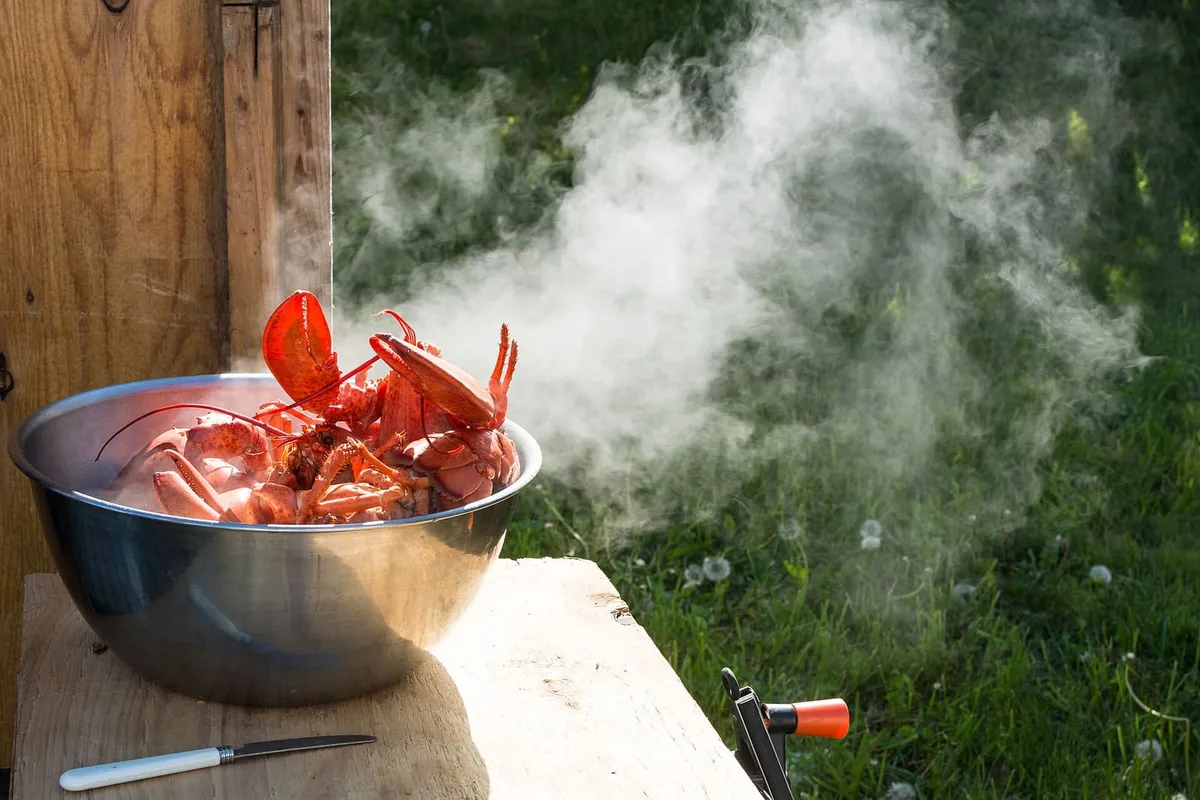
To cook lobster the Nova Scotia way, plunge a lively, live lobster head first into a big pot of water salted like the sea, cover it, and simmer for about 7 to 10 minutes for the first pound plus 2 to 3 minutes for each extra pound. That’s the Lobster Council of Canada’s guideline. It’s done when an antenna pulls out with a gentle tug and the tail meat is opaque white. Steaming over a little salted water works just as well and takes a few minutes longer. Serve it hot with melted butter.
That’s the short version. This guide covers every common method (boiling, steaming, grilling and broiling), the gear, timing charts from three published sources, food safety and what to do with leftovers. If you still need lobsters, start with our guide on how to buy live lobster in Nova Scotia. If you’d rather someone else did the cooking, see where to eat lobster in Nova Scotia. For more recipes and techniques, browse the cooking and recipes topic hub.
How to cook lobster: the methods at a glance
| Method | Best for | Typical time for a 1½ lb (680 g) lobster | Notes |
|---|---|---|---|
| Boiling | Whole live lobsters, feeding a crowd | About 9–12 min | Seasons the meat; easiest to time |
| Steaming | Whole live lobsters, smaller batches | About 12–18 min | Gentler and harder to overcook; needs a rack |
| Grilling | Raw split halves | 7–9 min | Smoky flavour; split or blanch first |
| Broiling | Raw split lobster, or tails | About 15 min (split whole) | Butter-basted, oven-based |
The times come from the Lobster Council of Canada, Clearwater Seafoods’ cooking guide and the Maine Lobster guide. The sources don’t agree to the minute, so treat any time as the point where you start checking, not a guarantee.
Before cooking live lobster: what you need to know
Whole lobster in Nova Scotia is sold live, and it has to stay that way until it hits the pot. The Lobster Council of Canada is blunt about it: whether you buy from a pound, a store or by shipment, “lobster must be cooked live.” Its handling guide adds two rules:
- A sluggish lobster should be cooked right away.
- A lobster that doesn’t respond at all may be dead and should be thrown out.
Between the shop and the stove, live lobster keeps about 36 to 40 hours out of water in a cool, damp place, such as an open container in the fridge with damp newspaper or towels over it. Keep it away from fresh water of any kind, including melting ice. Lobsters are saltwater animals, and fresh water kills them.
How much to buy. The Lobster Council suggests 1 to 1½ lb of whole lobster per person, or 4 to 6 oz of tail per serving. A 1½ lb hard-shell lobster gives about 1⅓ cups of cooked meat. Our lobster buying guide explains how to pick a lively hard-shell lobster and how sizes are named at the counter.
Why Nova Scotia lobster is available most of the year. Different fishing areas open at different times, from the winter-spring season in the southwest to spring seasons on the Northumberland Strait and in Cape Breton. Our guide to the Nova Scotia lobster season has the dates for each area.
What equipment do you need to cook a whole lobster?
You don’t need much, but a big enough pot matters more than anything else.
- A large pot with a lid. The Maine Lobster guide says a 4 to 5 gallon (15–19 L) pot handles 6 to 8 lb of lobster. Clearwater says the water should fill no more than half the pot, to leave room for the lobsters and the boil.
- A steaming rack (for steaming). Clearwater notes a sieve or the lid of a smaller pot will do.
- Long tongs, for moving lobsters in and out.
- A timer, and ideally an instant-read thermometer.
- A large heavy knife if you plan to split lobsters for the grill or broiler.
- Crackers, picks and kitchen shears for the table, plus bowls for shells and plenty of napkins.
- Melted butter and lemon for serving.
If you’re cooking a lot of lobsters, use two pots or cook in batches. An overloaded pot takes too long to return to the boil, and the timing chart stops meaning anything.
Should you boil or steam lobster?
Boiling is the Maritime tradition. The Dictionary of Canadianisms on Historical Principles defines a lobster supper as “a meal of boiled lobster and side dishes”, with citations going back to 1899. Boiling in salty water is fast, easy to time and seasons the meat. Steaming has its fans too. The Nova Scotia seafood company Clearwater sums up the trade-off in its cooking guide. Steamed lobster may need more time, but the gentler heat gives “a more tender and juicy lobster with less chance of overcooking”. On the other hand, steaming “does not impart the desired saltiness” that boiling in salted water does.
| Boiling | Steaming | |
|---|---|---|
| Water needed | Enough to fully cover the lobsters | 1–5 cm (½–2 in) |
| Seasoning | Salted water flavours the meat | Milder; season at the table |
| Speed | Faster | A few minutes longer |
| Risk of overcooking | Higher | Lower |
| Best for | Large batches, lobster suppers | Smaller batches, a pot without much room |
A good rule: boil when you’re feeding a crowd, and steam when your pot is small or you’re cooking just two or three lobsters.
How to boil lobster, step by step
- Fill the pot and salt the water. Use enough water to fully cover the lobsters, but don’t fill the pot more than halfway. Salt it until it tastes like the sea (see below). Bring it to a full, rolling boil.
- Get the lobsters ready. Take them out of the fridge just before cooking. Leave the bands on the claws.
- In they go, head first. Grasp each lobster by the back and plunge it head first into the boiling water, one at a time. Cover the pot.
- Time it. Start the timer (see “When do you start the timer?” below). The Lobster Council says to simmer covered for 7 to 10 minutes for the first pound and 2 to 3 minutes for each extra pound, and to add a little time when cooking several at once. The Maine Lobster guide suggests stirring the lobsters halfway through.
- Check for doneness on the biggest lobster before you take any out (see the doneness section below).
- Rest and serve. Lift the lobsters out with tongs and let them drain. The Maine Lobster guide recommends a 5-minute rest. If you’re not eating them right away, Clearwater says to chill them quickly in ice water, then drain, cover and refrigerate.
How salty should the water be?
The traditional answer is “like the sea”, and the Lobster Council’s instructions say salted water “or seawater!” If you use seawater, take it from clean water well away from wharves and outfalls. With tap water, the published guidance varies:
- Clearwater: ½ cup of sea salt or kosher salt per 4 litres (1 gallon) of water.
- Maine Lobster guide: ¼ cup of sea salt per gallon.
Either works. More salt gives more seasoned meat. Clearwater also suggests an optional court bouillon: carrots, onion, parsley, celery, seasonings and white wine vinegar or lemon juice simmered in the water for 2 to 3 minutes before the lobsters go in.
How to steam lobster, step by step
- Set up the pot. The Lobster Council of Canada uses ½ inch (about 1 cm) of water with 1 tablespoon of salt and 1 tablespoon of vinegar. Clearwater uses about 2 inches (5 cm) of water with a steaming rack, which is easier to manage in a big pot.
- Bring the water to a rolling boil.
- Add the lobsters, cover tightly and start timing.
- Steam about 15 minutes for a 1 lb lobster, plus 5 minutes for each extra pound (Lobster Council of Canada). Halfway through, carefully lift the lid, watching for hot steam, and rearrange the lobsters so they cook evenly.
- Watch the water level. With only a little water in the pot, it can boil dry during a long steam.
- Check doneness and serve.
Lobster cooking time by weight
Here are the three sources side by side. The Lobster Council gives a formula, and we’ve worked out the range for each weight. Clearwater times from when the water returns to the boil. The Maine Lobster guide starts timing as soon as the lid goes on.
Boiling
| Lobster weight | Lobster Council of Canada (calculated from its formula) | Clearwater chart | Maine Lobster guide |
|---|---|---|---|
| 1 lb (450 g) | 7–10 min | 8–9 min | 8 min |
| 1½ lb (680 g) | 8–11½ min | 9–11 min | 11–12 min |
| 2 lb (900 g) | 9–13 min | 18–20 min (2–3 lb) | 15 min |
| 3 lb (1.4 kg) | 11–16 min | 18–20 min (2–3 lb) | 25 min |
| 5 lb (2.3 kg) | 15–22 min | 20–25 min (3½–5 lb) | 35–40 min |
Steaming
| Lobster weight | Lobster Council of Canada (calculated) | Clearwater chart |
|---|---|---|
| 1 lb (450 g) | 15 min | 11 min |
| 1½ lb (680 g) | About 17–18 min | 12–14 min |
| 2 lb (900 g) | 20 min | 20–23 min (2–3 lb) |
| 3 lb (1.4 kg) | 25 min | 20–23 min (2–3 lb) |
The charts agree closely for the 1 to 1½ lb lobsters you’ll usually find at a Nova Scotia counter. For big lobsters they differ by 10 minutes or more. That’s because they time from different moments, use different amounts of water and assume different pot loads. With a lobster over 2 lb, start checking at the low end of the range and keep checking every couple of minutes.
When do you start the timer?
This is the biggest source of confusion. The Maine Lobster guide says to cover the pot and “start timing immediately.” Clearwater says to let the water return to a boil, then set the timer. With a full pot and cold lobsters, the gap between those two moments can be several minutes. Choose one approach, use the matching chart, and check for doneness either way.
A trick for big lobsters
In a big lobster, the tail tends to finish before the claws. Clearwater’s chefs suggest taking the lobster out about 3 minutes early, twisting off the tail and setting it aside, then returning the body and claws to the pot for the last 3 minutes. It isn’t required, but you get evenly cooked meat.
How do you know when lobster is done?
Don’t go by the colour. Clearwater points out that lobsters turn bright red “well before the meat is thoroughly cooked inside.” Use one or more of these checks instead:
- The antenna test. Tug an antenna or one of the small walking legs. It should pull away easily (Lobster Council of Canada).
- Look at the tail meat. Crack the shell where the tail meets the body. The meat should have turned from translucent to white (Maine Lobster guide).
- Look inside the body. The tomalley should be green, and any roe in a female should be bright red and firm. If the roe is dark black and tar-like, the lobster is undercooked (Clearwater).
- Take its temperature. Clearwater cooks to an internal 78°C (172°F) and describes a cooked lobster as reaching 80°C (180°F).
What temperature should cooked lobster reach?
Health Canada’s safe cooking temperatures list 74°C (165°F) for shellfish and crustaceans, lobster included. Push an instant-read thermometer into the thickest part of the tail from the underside. If it reads 74°C or higher and the meat is opaque, it’s safe. Clearwater’s 78–80°C target sits a little above that.
How to grill lobster
Grilled lobster has a light smoky edge. It starts with a raw lobster split in half.
- Split the lobster. The Lobster Council’s method: lay the lobster flat and push the point of a heavy knife into the well-defined cross on the back of the head, facing the tail, then cut through lengthwise. The Council says the lobster dies instantly and that any movement afterwards is residual nerve twitching. If you’d rather not cut a live lobster, blanch it in boiling water for 2 to 3 minutes first.
- Prepare the grill at medium-high heat.
- Oil and season. Brush the shells with olive oil and lay the halves meat side up. Brush the meat with oil and season with salt and pepper.
- Grill covered until the meat is just opaque in the thickest part of the tail, 7 to 9 minutes.
To finish lobster that’s already cooked on the grill, Clearwater suggests placing the halves meat side down for 3 minutes, then flipping and basting with butter. Cover and cook for another 5 minutes, just until heated through.
How to broil lobster or lobster tails
A whole split lobster. Split it as above, lay it split side up, brush it lightly with butter and broil about 4 inches (10 cm) below the element. The Lobster Council gives about 15 minutes for a 1½ lb lobster.
Lobster tails. Thaw frozen tails slowly in the fridge, never on the counter. The Lobster Council’s handling guide warns that warm-water or room-temperature thawing causes quality and drip loss. Clearwater’s cooking chart gives these times for tails:
| Tail method | Clearwater time |
|---|---|
| Broiled | 6 min, flip, 5 min |
| Grilled | 4 min, flip, 7 min |
| Steamed | 11 min |
Times depend on tail size and how hot your broiler runs, so check that the meat is opaque and has reached at least 74°C.
Is there a humane way to cook a lobster?
It’s a fair question, and the science has moved. In 2021, a review commissioned by the UK government and led by Dr Jonathan Birch at the London School of Economics looked at more than 300 scientific studies. It concluded that decapod crustaceans, which include lobsters, “should be regarded as sentient.” It recommended against “extreme slaughter methods such as live boiling without stunning.”
In practice, the quickest option most home cooks have is the knife method described in the grilling section. The Lobster Council of Canada says splitting through the cross on the head kills the lobster instantly. Do it just before the lobster goes into the pot, onto the grill or under the broiler. Whatever method you choose, work quickly and don’t leave lobsters sitting out longer than you need to.
Food safety: tomalley, leftovers and storage
Tomalley. The soft green tomalley in the body works as the lobster’s liver and pancreas. Some people love it. In a reminder published in 2013 and now archived, Health Canada advised that children should not eat lobster tomalley. It advised adults to limit themselves to the tomalley from one cooked lobster a day. The concern is that a very small number of lobsters may carry paralytic shellfish poison in the tomalley. Health Canada recommends no restrictions on eating lobster meat. For more on what’s inside a lobster, see our American lobster facts guide.
Leftovers. The two sources give different storage times:
- The Lobster Council of Canada says cooked lobster keeps up to three days in airtight containers in the fridge, and picked meat up to four days.
- Clearwater’s guide is more conservative, at 1 to 2 days for cooked lobsters.
If you’re unsure, eat leftovers sooner rather than later. Cool cooked lobster quickly in ice water before refrigerating it. You can freeze cooked meat if you won’t get to it in time.
Frozen lobster meat. The Lobster Council says to thaw cans or pouches in cold water in the fridge, allowing about two hours per pound. Eat the meat within 24 to 36 hours of thawing.
How to serve lobster the Nova Scotia way
The classic Nova Scotia plate is simple: a whole boiled lobster with a dish of melted butter. Clearwater’s guide describes whole lobster as “usually eaten with melted butter for dipping, accompanied with salad or steamed vegetables.” At a traditional lobster supper, such as the long-running suppers at Hubbards on the South Shore, boiled lobster comes with mussels, salads, homemade rolls and dessert. Our region-by-region restaurant guide lists them.
Getting the meat out. Clearwater’s step-by-step version:
- Twist off the claws and separate each claw from its knuckle.
- Break off the small hinged part of the claw, then crack the claw and remove the meat. Use a pick for the knuckles.
- Twist the tail away from the body. Squeeze or cut along both sides until the shell cracks, snap off the tail flippers and push the meat out in one piece.
- Peel back the flap on top of the tail meat and remove the dark vein.
- Nibble the meat out of the walking legs. It’s fiddly but sweet.
Save the shells. They make a good stock for chowder or bisque.
Common mistakes when cooking lobster
- Cooking a dead lobster. If it doesn’t respond, don’t cook it.
- Storing lobsters on ice or in tap water. Fresh water kills them. Use damp paper or towels in the fridge.
- Crowding the pot. Too many lobsters and the water takes ages to return to the boil. Cook in batches.
- Mixing sizes. Clearwater advises cooking similar-sized lobsters together. If you can’t, time the batch for the biggest one.
- Trusting the red shell. Use the antenna test, the colour of the tail meat or a thermometer.
- Walking away. Lobster goes from tender to rubbery quickly. Start checking at the low end of the chart.
Once you’ve cooked a few, you’ll know your pot and stove, and you won’t need the chart. Until then, pick a method, follow one timing source and check the biggest lobster before you serve. For the bigger picture, including where the lobster comes from, read our complete guide to Nova Scotia lobster.
Frequently asked questions
How long do you boil a 1 lb lobster?
The Lobster Council of Canada says 7 to 10 minutes for the first pound in covered, salted water at a rolling boil. Clearwater's chart gives 8 to 9 minutes and the Maine Lobster guide 8 minutes. Check that an antenna pulls out easily and the tail meat is white before you take it out.
Is it better to boil or steam lobster?
Both work. Boiling in well-salted water seasons the meat and is quicker to time. Steaming is gentler and less likely to overcook the meat, but it takes a few minutes longer and adds less salt. Boiled lobster is the Maritime tradition.
How much salt do you put in water to cook lobster?
Clean seawater is traditional. With tap water, Clearwater recommends about ½ cup of sea or kosher salt per 4 litres (1 gallon); the Maine Lobster guide uses ¼ cup of sea salt per gallon.
How do you know when lobster is cooked?
An antenna or small walking leg pulls away easily, the tail meat where it joins the body is firm and white rather than glassy, the tomalley is green and any roe is bright red and firm. The red shell alone is not a reliable sign. Health Canada lists 74°C (165°F) as the safe internal temperature for crustaceans.
Do you put a lobster in boiling water head first?
Yes. The Lobster Council of Canada says to hold the lobster by the back and plunge it head first into water at a full rolling boil, then cover the pot.
Sources
We check facts against primary sources wherever possible. Season dates and regulations can change, so confirm with Fisheries and Oceans Canada before you rely on them.
- Preparing Lobster — Lobster Council of Canada
- Handling Lobster — Lobster Council of Canada
- Clearwater Lobster: how to eat, cook and store lobster (cooking guide brochure) — Clearwater Seafoods, 2019
- How to Boil Lobster — Maine Lobster Marketing Collaborative (Lobster from Maine)
- Safe cooking temperatures — Health Canada
- Health Canada reminds Canadians about consumption of lobster tomalley — Health Canada (Recalls and safety alerts, archived), 2013-05-27
- Octopuses, crabs and lobsters to receive welfare protection — London School of Economics and Political Science, 2021-11-19
- lobster supper — Dictionary of Canadianisms on Historical Principles (University of British Columbia)
Image credits
- Header photo: Photo: Jeremy T. Hetzel via Wikimedia Commons · CC BY 2.0 (cropped and resized)
boilingsteaminggrillingbroilingcooking timeslive lobsterfood safety