How Are Lobsters Caught? Trap Fishing in Nova Scotia, Step by Step
How are lobsters caught in Nova Scotia? Baited traps, hydraulic haulers, measuring gauges and claw bands: the lobster fishing process from wharf to buyer.
By NovaShell Editorial Team · · 8 min read
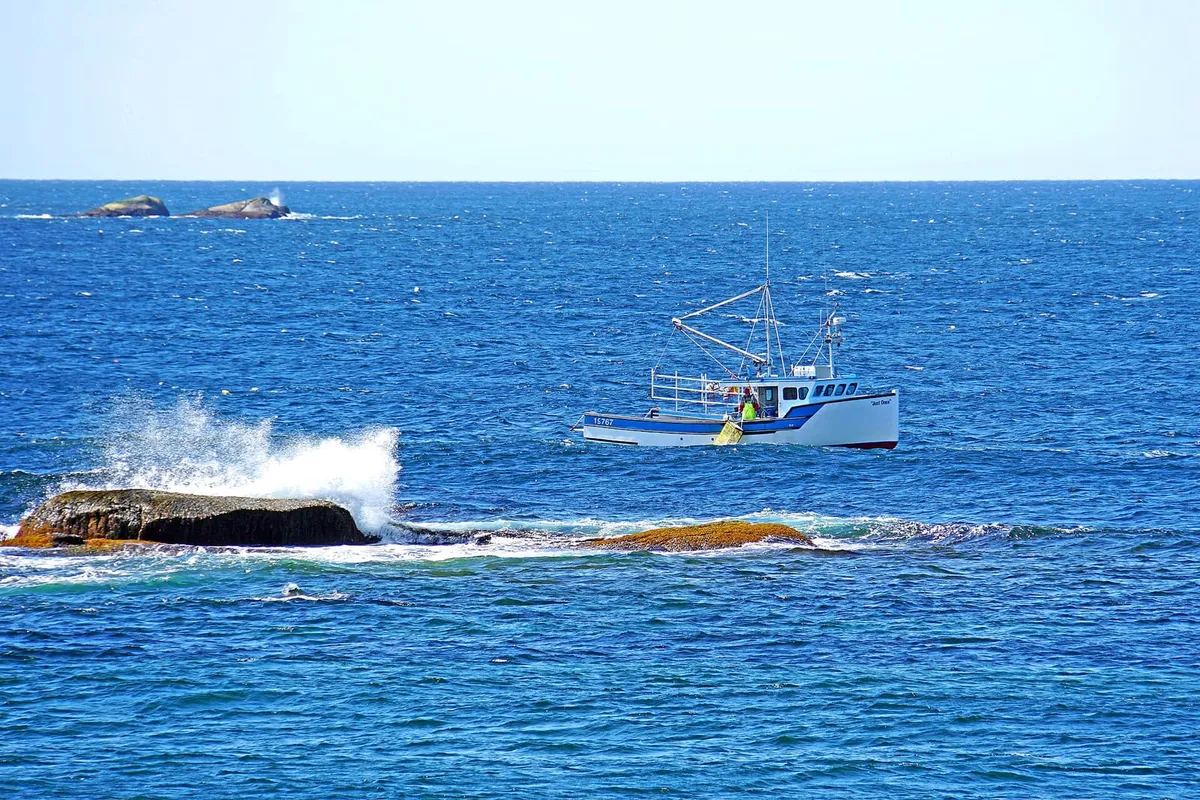
How are lobsters caught? In Nova Scotia, only one way: in baited traps fished from a boat. Federal rules say no one may fish for lobster “except from a vessel and with a lobster trap,” so every lobster you buy here was lured into a trap on the sea floor, hauled up by a powered hauler, measured, banded and landed alive at a wharf. The details vary by area and season, but the lobster fishing process follows the same basic rhythm from Cape Breton to Yarmouth.
This guide walks through that process step by step, from loading traps on the wharf to selling the catch. For the bigger picture of the industry, start with our complete guide to Nova Scotia lobster, and for when each area fishes, see the Nova Scotia lobster season dates.
How are lobsters caught? The short version
| Step | What happens | Who does it |
|---|---|---|
| 1. Load and steam | Traps, bait and crates go aboard; the boat runs to the grounds | Whole crew |
| 2. Set | Baited traps are dropped on the bottom and marked with buoys | Captain positions; crew sets |
| 3. Soak | Traps sit, usually overnight or longer, while lobsters find the bait | — |
| 4. Haul | The buoy line is gaffed and run through a powered hauler | Deckhand at the hauler |
| 5. Sort and measure | Shorts, egg-bearing and protected females go back; keepers are gauged | Crew |
| 6. Band and crate | Claws are banded; keepers go into crates or a live tank | Crew |
| 7. Rebait and reset | Fresh bait goes in and the trap goes back over | Deckhand |
| 8. Land and sell | Crates are lifted to the wharf and sold to a buyer by the pound | Captain and buyer |
Why traps are the only legal lobster fishing method
The Atlantic Fishery Regulations restrict lobster fishing to traps, and they cap a trap’s size outside the offshore LFA 41 at 125 cm long, 90 cm wide and 50 cm high. Mobile gear such as dredges and trawl nets can’t even be carried aboard while fishing for lobster.
Traps suit the job because they catch lobsters alive and undamaged, and they let undersized ones walk back out through escape vents. Fisheries and Oceans Canada (DFO) traces today’s design to the parlour trap, which evolved in the early 1900s. A trap has a “kitchen,” where the bait hangs, and a “parlour,” where lobsters end up after trying to leave. We take the trap apart piece by piece in a separate guide to lobster trap anatomy.
Step 1: Loading the boat and steaming out
The day starts at the wharf, in the dark more often than not. A 2014 Globe and Mail report on an Eastern Shore crew in Lobster Fishing Area (LFA) 32 had the boat leaving at 3:20 a.m. “to avoid the breezy seas of the afternoon.”
On opening day the load is heaviest. In the southwest’s LFAs 33 and 34, boats on Dumping Day carry “300 to 400 traps,” a DFO manager told The Canadian Press in 2024, which makes them top-heavy and is why the first day is considered the most dangerous. Distances matter too: in 2010 an LFA 34 fishermen’s representative told CBC that some crews face “four or five hours to travel” to their grounds.
Step 2: Setting the traps
Each trap is baited and dropped to the bottom on a line that runs up to a buoy painted in the fisher’s own colours. How traps are grouped depends on the area, the bottom and local habit:
- Single traps, each with its own buoy line.
- Trawls (strings), several traps tied along one ground line with a buoy at each end. The Pictou-Antigonish library glossary notes that trawls of three, five, seven and ten traps are common in the southern Gulf of St. Lawrence.
Wherever they’re set, traps are weighted so they stay put. DFO’s management plan notes that the trap footprint on the bottom is small and that “traps are weighted to restrict movement caused by currents.” Every trap must carry a valid DFO trap tag: licence holders receive a yearly set of consecutively numbered tags matching their trap limit, and fishery officers check them to enforce that limit.
On Dumping Day in LFA 33 and 34, the rule historically has been to set on the first day and haul later. CBC reported in 2010 that traps “are not to be hauled until the next day” and that fishers could begin pulling them at midnight.
Step 3: Soak time
Once set, traps “soak” while lobsters follow the scent of the bait inside. There is no single rule for soak time; it depends on catch rates, weather and how far the grounds are from the wharf.
- In the spring Eastern Shore fishery, the 2014 Globe and Mail report described a captain who “checks every trap every day.”
- In southwest Nova Scotia’s winter fishery, weather often decides. A 2015 CBC report from West Pubnico noted that some crews stay out for two to three days at a time, since many boats can hold around 9,000 kg of lobster.
DFO lists soak time among the factors that shape how much a trap affects the bottom, alongside weights, anchors and the type of rope used.
Step 4: Hauling lobster traps with a hydraulic hauler
Hauling lobster traps used to be done by hand. DFO interviews on the Atlantic coast found that in 1983 about a fifth of boats in LFA 33 still hauled by hand and only about half used hydraulic haulers. By 1998, every boat surveyed had a hydraulic trap hauler.
The sequence is quick:
- The captain brings the boat up to the buoy.
- A crew member catches the line with a gaff, a pole with a hook on the end.
- The line goes into the hauler, which winds the trap up off the bottom.
- When the trap reaches the rail, the crew swings it aboard onto the washboard.
DFO’s plan stresses that “proper hauling results in minimal dragging of the trap along the bottom.” It’s also the busiest moment on deck, with rope running through the hauler and heavy traps swinging aboard, so crews work to a set routine.
Step 5: Sorting and measuring the catch
The trap is opened and emptied by hand. Anything that can’t be kept goes straight back into the water:
- Undersized lobsters (“shorts”). Legal size is measured on the carapace, “from the rear of either eye socket to the rear end of the carapace,” using a metal gauge. In most Maritimes inshore areas the minimum is 82.5 mm; in LFAs 28 and 29 it is 84 mm.
- Egg-bearing (“berried”) females. No one may possess a female lobster with eggs attached.
- V-notched females. In most Maritimes LFAs, females marked with a notch in the tail flipper are protected breeders and must be released.
- Other species. Non-approved bycatch must be returned. Licence holders may keep some incidental rock crab, green crab and sculpins, mostly for bait, and must log them.
The 2014 Globe and Mail account describes the crew tossing back “pregnant females and undersized chicks” before measuring the keepers and checking for eggs or a v-notch. Our pillar on Nova Scotia lobster regulations covers size limits and female protections area by area.
Step 6: Banding the claws and crating the keepers
Every keeper gets a band around each claw so it can’t crush another lobster or a crew member’s finger. On the boat in the Globe and Mail story, one crew member measured, then “bands the claws of the keepers before packing them into grey plastic 100-pound crates, the most common object in the lobster business.”
Crated lobsters need to stay cool, wet and out of sun and wind. Some boats hold the catch in a live tank on deck supplied with pumped seawater, which the Pictou-Antigonish library glossary describes as a box-like container in the middle of the deck. Careful handling here pays off later in price and survival, especially when the catch includes softer, recently moulted lobsters; see hard-shell vs soft-shell lobster for why shell condition matters.
Step 7: Rebaiting and resetting
While one person bands, another fills a fresh bait bag and swaps it into the trap. The Globe and Mail crew used “redfish heads or mackerel or gaspereau or occasionally a sculpin on a spike.” When the captain has the boat in position, the trap goes back over the side and the crew moves to the next buoy. That crew could haul, empty, rebait and reset a trap “in less than three minutes.”
Step 8: Landing at the wharf and selling
At the end of the trip the crates are lifted onto the wharf and either sold straight to a shore buyer or held in seawater until the buyer arrives. In the Globe and Mail report, the crew finished by 10:30 a.m., moved six crates into “a tank of cold circulating sea water,” and the buyer collected 590 pounds at 1:40 p.m. In the southwest, CBC reported in 2015 that “thousands of pounds of live lobster” were being held in water off the wharves waiting to be sold.
Two pieces of paperwork follow every trip:
- The price slip. Lobster is sold by the pound at the shore price of the day.
- The logbook. Logbooks are the main source of DFO’s catch and effort data, and in Maritimes Region they must go to a certified dockside monitoring company. Licences aren’t reissued until the previous season’s logs are in.
From there, the catch goes to a lobster pound, a processor or straight onto a truck or plane for the live market. If you’re buying for your own table, our guide to buying live lobster in Nova Scotia explains what to look for.
How lobster fishing methods differ around Nova Scotia
The steps above are universal, but the details shift with the area:
| Area | Season (usual) | What’s different |
|---|---|---|
| LFAs 33 and 34, South Shore and Southwest | Last Monday of November to May 31 | Dumping Day mass setting, winter weather, long trips; DFO found in the late 1990s that most of LFA 33’s catch came in the first two weeks of the season |
| LFAs 31A, 31B and 32, Eastern Shore | Spring | Day trips; a 2014 LFA 32 crew hauled every trap daily |
| LFA 35, upper Bay of Fundy | Fall and spring | Split seasons; see our LFA 35 lobster season guide |
| LFAs 25, 26A, 26B, Northumberland Strait and western Cape Breton | Varies by area | Trawls of three to ten traps are common in the southern Gulf |
Boats differ too. DFO says the inshore fishery is fished “almost entirely by vessels less than 13.7 m (45’),” with larger maximums in some areas. Crew sizes averaged about 2.2 people per boat in LFA 33 and about 3 in LFA 34 between 2014 and 2018. For a map of who fishes where, see our guide to Nova Scotia’s lobster fishing areas, and browse more on the industry in the lobster fishing industry hub.
Frequently asked questions
How are lobsters caught in Nova Scotia?
Only with baited traps fished from a boat. Federal regulations say no one may fish for lobster except from a vessel and with a lobster trap. Fishers set traps on the bottom, leave them to soak, then haul them with a powered hauler, keep legal-sized lobsters, band their claws and land them alive at the wharf.
How often do lobster fishermen haul their traps?
It depends on the area, the season and the weather. A Globe and Mail report from Lobster Fishing Area 32 in 2014 described a captain checking every trap every day. In the winter fishery off southwest Nova Scotia, weather often decides, and some crews stay out two to three days at a time.
Can you catch lobster with your hands or a spear in Nova Scotia?
No. Federal regulations allow lobster to be fished only from a vessel and with a lobster trap, and DFO says there is currently no authorized recreational lobster harvest in the Maritimes inshore fishery.
Why are lobster claws banded?
Bands keep the claws shut so lobsters can't injure each other or the people handling them in crates, tanks and shipping boxes. Crews band keepers on deck, right after measuring.
What happens to undersized or egg-bearing lobsters?
They go straight back into the water. Possessing a lobster below the legal carapace length or a female carrying eggs is prohibited, and most Maritimes areas also restrict v-notched females.
Sources
We check facts against primary sources wherever possible. Season dates and regulations can change, so confirm with Fisheries and Oceans Canada before you rely on them.
- Atlantic Fishery Regulations, 1985 (SOR/86-21), sections 57 to 61.1 (lobster) — Justice Laws Website, Government of Canada
- Lobster Fishing Areas 27–38: Integrated Fisheries Management Plan — Fisheries and Oceans Canada, 2022
- Lobster Fishing Effort on the Outer Coast of Nova Scotia, 1983 Versus 1998 (Research Document 2002/022) — Fisheries and Oceans Canada, Canadian Science Advisory Secretariat, 2002
- Cheap at sea, pricey on the plate: The voodoo of lobster economics — The Globe and Mail, 2014-07-11
- About 1,450 lobster boats to head out on Day 1 of Canada's largest lobster fishery — CBC News / The Canadian Press, 2024-11-25
- Southwest Nova Scotia lobster fishery hauls big catches in good weather — CBC News, 2015-12-10
- Southwest N.S. lobster season opens — CBC News, 2010-11-29
- Lobster in the Northumberland Strait: Glossary — Pictou-Antigonish Regional Library
Image credits
- Header photo: Photo: Dennis G. Jarvis via Wikimedia Commons · CC BY-SA 2.0 (cropped and resized)
lobster trapslobster fishing methodshaulingLFA 33LFA 34Eastern Shore