Lobster Molting: How Lobsters Grow by Shedding Their Shells
Lobster molting explained: how a lobster sheds its shell, how often it happens, when Nova Scotia lobsters moult, and why soft shells matter to the fishery.
By NovaShell Editorial Team · · 7 min read
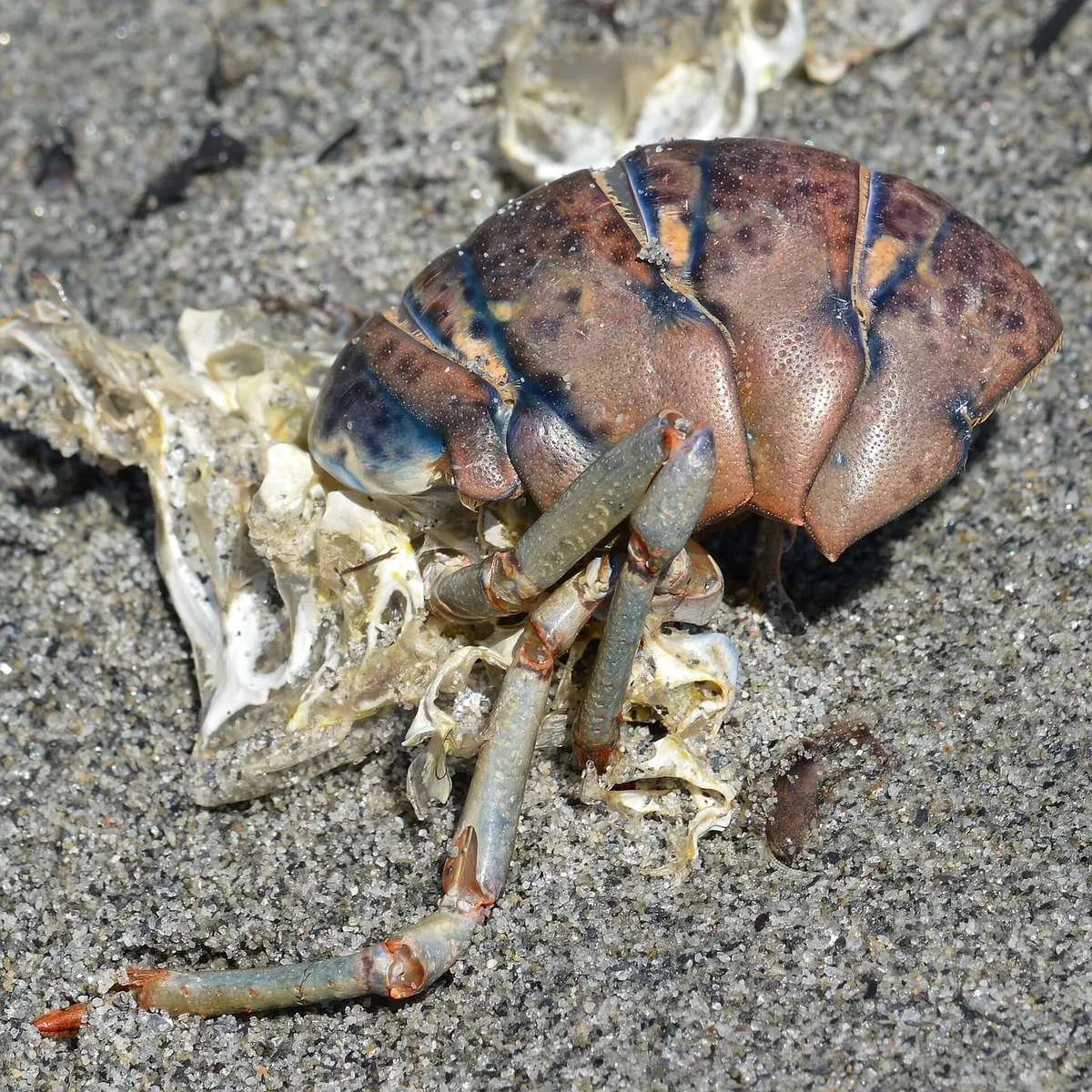
Lobster molting is how a lobster grows: because its skeleton is on the outside, it has to build a new, larger shell underneath the old one, crack out of the old armour, pump itself up with water and then harden again. Young lobsters do this many times a year. A Nova Scotia lobster near the minimum legal size moults about once a year, usually in summer, and big lobsters moult only every two to three years.
Moulting (the Canadian spelling) shapes almost everything about Nova Scotia lobster, from when seasons open to why a lobster you buy in December can feel different from one in May. For the wider biology, see our pillar guide to American lobster facts.
How do lobsters molt? The process step by step
Diane Cowan, executive director of The Lobster Conservancy in Maine, describes the moult cycle in three phases: preparing (premolt), shedding (ecdysis) and recovering (postmolt). Her 2019 account in Fishermen’s Voice is one of the clearest descriptions available.
Before the moult
Weeks ahead of shedding, the lobster quietly rebuilds itself. According to Cowan, it:
- Grows a new, larger, soft shell folded up beneath the old one.
- Regrows missing parts such as claws, antennae and legs.
- Pulls calcium out of the old shell by dissolving its edges and joints.
- Stores calcium in its blood and in two hard deposits on either side of the stomach called gastroliths (“stomach stones”).
- Shrinks the muscle in its big claws so they can slip through the narrow knuckle joints.
Pre-moult lobsters also act differently. They spend more time in the open, barricade their shelters and generally fidget.
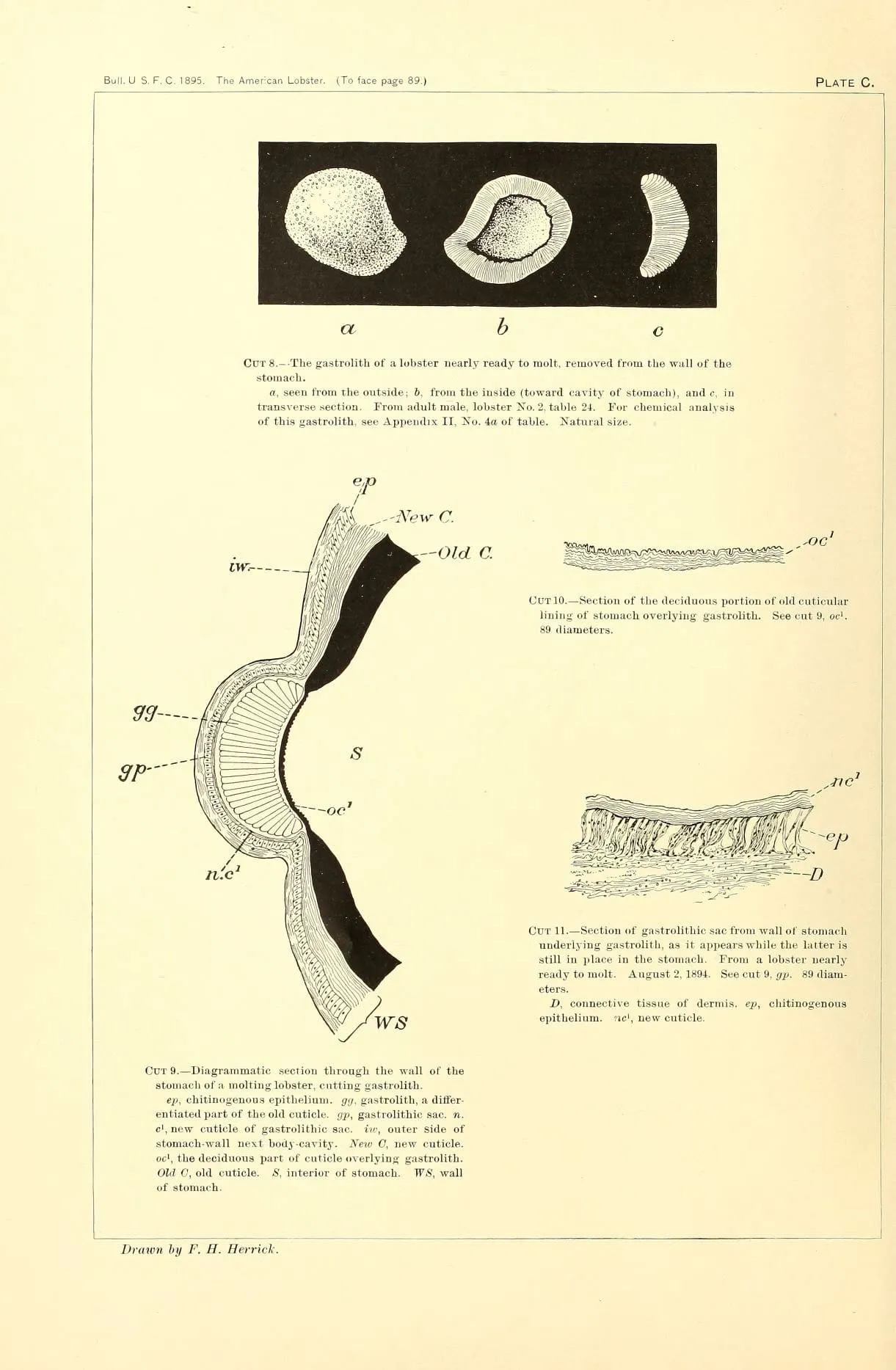
Photo: Francis Hobart Herrick via Wikimedia Commons, CC BY 2.0. A gastrolith from a lobster about to moult, drawn for the U.S. Fish Commission in 1895.

Shedding the shell
When it’s ready, the lobster swallows water to build pressure. The membrane where the body meets the tail stretches and splits, and the lobster lies on its side and backs out of the old shell. Fisheries and Oceans Canada’s (DFO’s) 1988 Underwater World booklet on the lobster describes it arching its body into a “V” before it pulls free.
It isn’t only the outer shell that comes off. Cowan notes that the lobster also sheds the lining of its gills, its stomach and even the covering over its eyes. The slowest part is pulling the claws out. She estimates the hard part of shedding takes a one-pound lobster about half an hour once it’s on its side, and at least another 30 minutes for a 10-pounder.
After the moult
A freshly moulted lobster is, in the words of DFO scientist Brad Hubley, “like jelly.” It keeps swallowing water and puffs up to its new size. DFO’s 1988 booklet says that’s about 10 to 15 percent larger than before. The first parts to harden are the mouthparts, which it uses to eat the soft edges of its old shell.
Over the following weeks the lobster eats heavily, favouring calcium-rich food, draws on the calcium stored in its stomach wall, and often eats its cast-off shell. NOAA Fisheries also notes that lobsters sometimes eat their discarded shell to replace lost calcium. Once its flesh fills the new shell, DFO says a lobster will be about 50 percent heavier than before the moult.
How often do lobsters molt?
Frequency drops steadily with age. Cowan gives this rough timeline for wild lobsters, and DFO’s figures for legal-sized lobsters line up with it:
| Stage | How often it moults |
|---|---|
| Drifting larvae (first weeks) | 4 moults in the plankton |
| First year on the bottom | Up to about once a month from settlement to late fall |
| Second year | About 4 times |
| Third and fourth years | 2 or 3 times a year |
| Fifth and sixth years | Once or twice a year |
| Near legal size, about 0.45 kg (1 lb) | About once a year (DFO) |
| About 1.4 kg (3 lb) | Every 2 to 3 years (DFO) |
NOAA says American lobsters moult roughly 20 to 25 times between hatching and reaching reproductive age and minimum legal size. In Nova Scotia’s colder water that takes longer: DFO estimates 8 to 10 years to reach the 82.5 mm carapace length legal size. Our article on how long lobsters live explains why that number is an estimate.
Each moult adds a meaningful chunk of size. DFO’s 2013 assessment of southwest Nova Scotia lobster reports a mean growth increment of 12 to 16 percent per moult for males and immature females. Mature females grow less per moult because more of their energy goes into eggs.
When is lobster moult season in Nova Scotia?
The short answer is summer, with big differences by area and year.
- Temperature sets the clock. Cowan writes that the bulk of the adult moult comes with rising water temperatures and longer days, and that a lobster’s new shell takes longer to harden in cold water.
- Warm water means more moults. DFO’s 1988 booklet notes that in the Northumberland Strait, where summer water can reach 20°C, a canner-sized lobster can moult twice in one year, while a lobster in cooler water would moult once.
- Southwest Nova Scotia watches it closely. CBC reported in 2016 that DFO scientists study catches and shell softness each June and July, after the time lobsters typically moult in that area. In the 2015 survey, only 1.23 percent had soft shells around the normal moulting time, compared with at least 27 percent in 2012, a sign of a late moult after a cold spring.
Mating is tied to the moult as well. DFO says the usual pattern is for a mature female to mate in late summer while she is still soft, immediately after moulting.
Why molting matters to lobsters: the soft-shell danger zone
A newly moulted lobster is at its most vulnerable. DFO’s management plan for LFAs 27 to 38 says that while larger lobsters are safe from all but the largest predators, all lobsters are most vulnerable immediately after the moult, when the shell is still soft. Cowan adds that lobsters are especially prone to injury and disease from a few days before shedding until a couple of weeks after.
Other risks pile up during this window:
- Low salinity. DFO’s 2013 assessment notes that moulting lobsters are less tolerant of low salinity than hard-shelled ones, because their skeletons are more permeable.
- Trap and tank mates. Soft lobsters get damaged by other lobsters in traps and holding tanks, Cowan says, including torn limbs, gill abrasions and internal injuries.
- Bycatch. DFO notes that crab traps can damage lobsters caught as bycatch, “particularly during the moulting period.”
How lobster molting shapes the Nova Scotia fishery
Season timing is partly about the moult. DFO lists seasons among its management tools, including closures during spawning, moulting and egg-extrusion periods. As the Lobster Council of Canada puts it, “In Atlantic Canada, we stagger our fishing seasons to give freshly-moulted soft shell lobsters the chance to fill-out their new shells.” Our guide to Nova Scotia lobster seasons shows how those dates fall across the province.
The fit isn’t always perfect, and the edges of a season can catch lobsters mid-moult. In 2026, DFO began a five-year pilot that shifts season dates in LFAs 27 to 32 (all but LFA 28) without changing their length. The 2026 notice says the aim is to “reduce the handling of egg-bearing or recently moulted lobster at the end of the season.”
A late moult can also ripple through the market. In 2016, CBC reported that a late moult in southwest Nova Scotia meant shells had less time to harden before the season opened in late November. One Barrington Passage plant manager said losses before shipping had risen from about 2 percent in earlier years to at least 5 to 10 percent. Hubley called it an environmental fluctuation rather than a long-term trend.
What molting means when you buy lobster
Moulting is the reason “hard-shell” and “soft-shell” (or “new-shell”) lobsters exist. Neither is unsafe, but they’re different products.
- Less meat, more water. DFO’s 1988 booklet says that for one to two months after a moult the flesh is watery and doesn’t quite fill the shell.
- Shorter shelf life. Soft lobsters don’t hold or ship as well, which is why buyers prize hard-shell lobster for the live trade. Our guide to storing live lobster has tips that matter even more for softer lobsters.
- Some people prefer them. The Lobster Council of Canada describes softer-shelled lobster from warmer waters as offering an “almost silken, sweet” eating experience.
For a side-by-side comparison, read hard-shell vs soft-shell lobster. And if you find an empty lobster shell on a Nova Scotia beach, Cowan offers a neat test: look at the eyes. Clear eye coverings mean it’s a moult, and the lobster that left it is still out there. Black eyes mean the shell belonged to a dead lobster.
More lobster science is collected on our lobster biology topic page.
Frequently asked questions
How often do lobsters molt?
Very often when young and less often with age. A lobster around the 1-pound minimum legal size generally moults about once a year, and DFO says a 3-pound (1.4 kg) lobster moults only every two to three years.
When do lobsters molt in Nova Scotia?
Mostly in summer, as the water warms. Timing varies by area and year. In southwest Nova Scotia, DFO scientists sample shell softness in June and July, after the usual moult, and a cold spring can delay it.
How long does it take a lobster's new shell to harden?
It takes weeks, not days. A 1988 DFO publication says the meat is watery and doesn't quite fill the shell for one to two months after a moult, and cold water slows hardening further.
Do lobsters eat their old shell?
Often, yes. After moulting, a lobster may eat its cast-off shell and other calcium-rich food to help harden its new one, and it also draws on calcium it stored in its stomach wall before the moult.
Are soft-shell lobsters safe to eat?
Yes. Soft-shell (new-shell) lobsters are the same animal at a different stage. They have less meat for their size and more water, and they don't survive storage and shipping as well as hard-shell lobsters.
Sources
We check facts against primary sources wherever possible. Season dates and regulations can change, so confirm with Fisheries and Oceans Canada before you rely on them.
- Lobster Fishing Areas 27 – 38: Integrated Fisheries Management Plan — Fisheries and Oceans Canada, 2022
- Consider the Lobster Molt (Diane F. Cowan, The Lobster Conservancy) — Fishermen's Voice, December 2019
- Underwater World: The Lobster — Fisheries and Oceans Canada, 1988
- Nova Scotia lobster industry facing challenging season — CBC News, 2016-03-13
- 2026 Lobster Fishing Areas 27-32 (Maritimes Region) — Fisheries and Oceans Canada, 2026
- Hard Shell or Soft Shell? — Lobster Council of Canada
- American Lobster species profile — NOAA Fisheries
- Assessment of lobster (Homarus americanus) off southwest Nova Scotia and in the Bay of Fundy (LFAs 34-38), Research Document 2013/078 — Fisheries and Oceans Canada, Canadian Science Advisory Secretariat, 2013
Image credits
- Header photo: Photo: Ryan Hodnett via Wikimedia Commons · CC BY-SA 4.0 (cropped and resized)
- 1895 scientific plate by Francis Hobart Herrick showing a lobster gastrolith from three angles and a cross-section of the stomach wall of a moulting lobster: Photo: Herrick, Francis Hobart via Wikimedia Commons · CC BY 2.0 (cropped and resized)
lobster moltingmoultingsoft-shell lobstergastrolithslobster biologyshell quality