The Lobster Life Cycle: From Egg to Adult
The lobster life cycle step by step: mating after the female's moult, a year carrying eggs, three larval stages, settling to the bottom and years to adulthood.
By NovaShell Editorial Team · · 8 min read
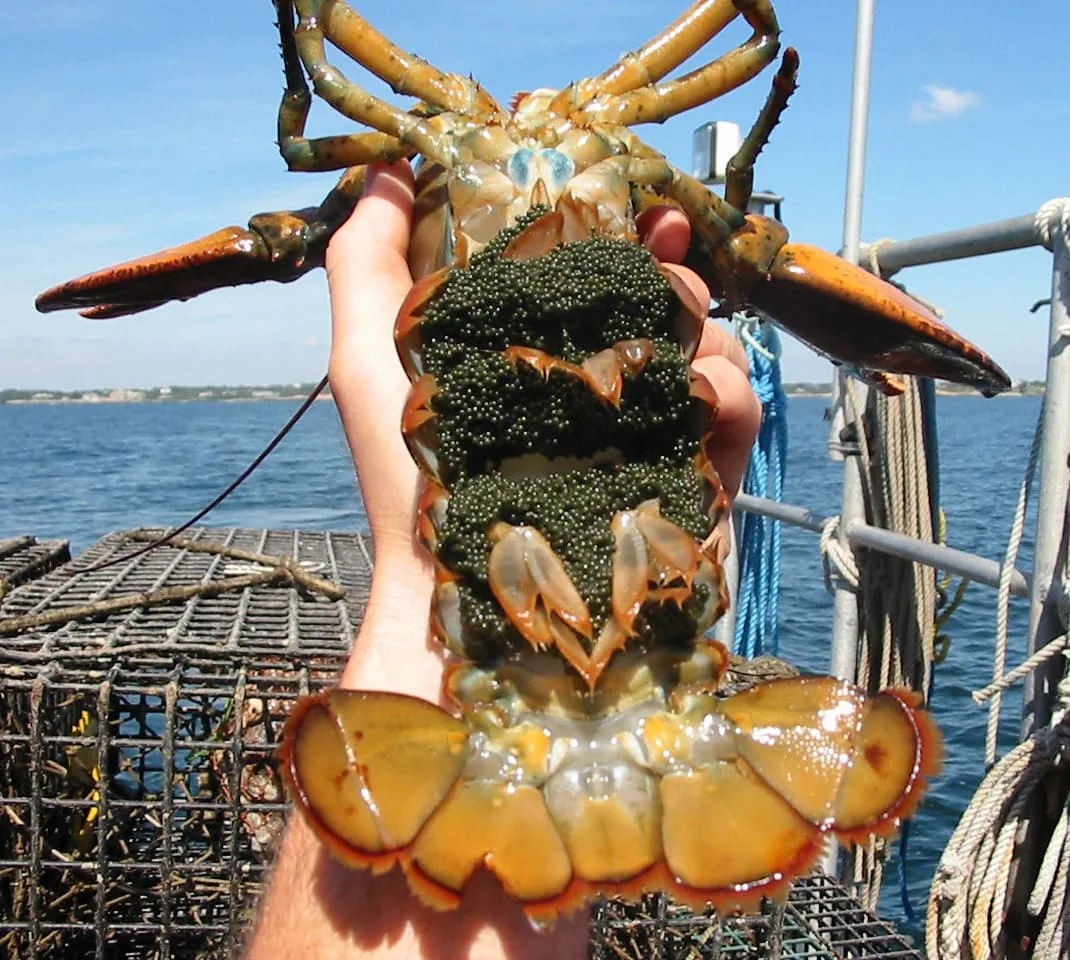
The lobster life cycle runs from a dark green egg glued under a female’s tail, through a few weeks as a drifting larva near the surface, to a hidden juvenile in a rocky crevice, and finally to an adult that may take five to ten years to grow up. Along the way a lobster survives long odds: by one Fisheries and Oceans Canada (DFO) estimate, only about 1 percent of floating larvae make it to the sea floor.
Here’s each stage in order, with Nova Scotia timing where we have it. For the wider biology of the species, see our guide to American lobster facts.
The lobster life cycle at a glance
| Stage | What happens | How long (approximate) |
|---|---|---|
| Mating | Female mates in late summer, soon after she moults | A few days |
| Egg development inside the female | Eggs ripen in her ovaries; sperm is stored | About a year |
| Egg extrusion and brooding (“berried” female) | Eggs fertilized and carried under the tail | 9 to 12 months |
| Hatching | Usually summer; June to September in Canadian waters | Varies with water temperature |
| Larvae (Stages I to III) | Drifting near the surface, feeding on plankton | Weeks, depending on temperature |
| Postlarva (Stage IV) | Looks like a tiny adult; dives to find shelter | Days to weeks |
| Juvenile | Lives in or near a shelter on the bottom | First 3 to 4 years mostly sheltered |
| Adult | Mature and able to breed | About 5 to 7 years to adulthood, varying with temperature |
Sources: DFO (1988, 2011, 2013, 2022) and NOAA Fisheries. Ranges vary by source, as noted below.
How do lobsters reproduce?
Lobster reproduction is tied to the moult. DFO’s 2011 publication A Lobster’s life on the bottom describes males and females forming a bond before and during mating. The female moults in the male’s shelter, mates with him and stays a few days. Then she moves off on her own and eats heavily while her new shell hardens.
Why the timing? A female is only receptive for a short window. DFO’s 1988 Underwater World booklet says she is sexually receptive for only a few days after moulting, while her shell is still soft and flexible. Our article on lobster molting explains what that soft-shell stage involves.
According to DFO’s management plan for LFAs 27 to 38, the usual pattern goes like this:
- Late summer: the mature female mates in her soft-shell condition immediately after moulting. The male transfers a sperm packet (spermatophore) into a seminal receptacle at the base of her tail.
- The following year: her eggs develop in her ovaries. NOAA Fisheries notes that she can store the sperm for up to a year.
- The next summer: she extrudes the mature eggs, fertilizes them as they pass the stored sperm, and attaches them to the swimmerets under her tail.
- About a year later: the eggs hatch, usually in July or August in DFO’s Maritimes Region.
From mating to hatching, the whole process takes about two years. That’s why mature females usually produce eggs only every second year. DFO also notes that males need to be about the same size as females or larger for successful mating, and that too few large males can reduce mating success.
Big females play by slightly different rules. DFO reports that females larger than about 120 mm carapace length can spawn twice without moulting in between, sometimes fertilizing both broods with sperm from a single mating.
Lobster eggs: life as a “berried” female
A female carrying eggs is called berried, and her eggs are the dark green mass you see in the photo above. DFO describes them as about the size of a grain of rice, dark green and irregularly shaped.
How many? It depends on her size:
| Female | Eggs carried |
|---|---|
| 78 mm carapace (a large “canner”) | About 7,500 |
| Typical large Bay of Fundy breeder | About 30,000 |
| Jumbo over 125 mm | More than 40,000 |
| Full range for the species | About 5,000 to more than 100,000 |
First three rows from DFO’s 1988 Underwater World booklet; the range is from NOAA Fisheries.
She carries them for a long time. Sources differ slightly on how long: DFO’s 2011 publication says 9 to 12 months, DFO’s management plan says 10 to 12 months, and NOAA says 9 to 11 months. Call it most of a year.
Because these females are the future of the fishery, the Atlantic Fishery Regulations say no one may buy, sell or possess a female lobster with eggs attached, so berried lobsters go back in the water. We explain why in berried female lobsters, and V-notching covers how fishers mark breeding females for extra protection. If you’ve ever found bright red “coral” inside a cooked female, that’s roe, covered in our article on tomalley and roe.
Hatching: when lobster eggs hatch in Nova Scotia
In Canadian waters, DFO says the eggs hatch between June and September, depending on water temperature. In the Maritimes the usual window is July or August. NOAA adds that egg-bearing females move inshore to hatch their eggs in late spring or early summer.
Newly hatched prelarvae stay attached to the female briefly. After a quick moult, Stage I larvae are released into the water column, within a few centimetres of the surface.
Lobster larvae: three stages in the plankton
This is the most dangerous part of a lobster’s life. DFO describes the larvae as transparent and about the size of a pea at first, growing to roughly thumbnail size by Stages II and III. They are weak swimmers, so wind and currents decide where they go.
DFO’s 2013 science assessment of southwest Nova Scotia lobster lays out the key facts:
- There are three larval stages followed by a postlarval stage (Stage IV).
- The larvae live mainly in surface waters but make a daily vertical migration.
- In the lab, Stages I to III take about 35 days at 12°C but only 22 days at 15°C.
- Development takes just 10 days at 22 to 24°C, but over 2 months at 10°C, and larvae need roughly 10 to 12°C to develop successfully to Stage IV.
DFO’s management plan sums the floating phase up as roughly 4 to 6 weeks. The larvae eat plankton, mainly cladocerans, copepods and crab larvae.
Survival is low. Larvae are eaten by larger zooplankton, jellyfish and comb jellies, and by fish such as mackerel and herring. DFO’s 1988 booklet estimated that only about 1 percent of floating larvae may settle on the ocean floor.
Settlement: a baby lobster finds the bottom
By Stage IV, the postlarva has the body shape of a tiny adult. DFO’s 1988 booklet puts it at about 15 mm long at this point. Halfway through Stage IV it leaves the surface and starts diving to search for shelter.
Where it lands matters enormously. DFO says postlarvae settle preferentially on bottoms that offer shelter, especially cobble. They have also been found in eelgrass and in hard clay or mud they can burrow into. The trip down is risky: shrimp, crabs, cunners, sculpins and even sea anemones prey on settling lobsters.
DFO has monitored lobster settlement at long-standing sites in the Bay of Fundy and, since 2005, at other locations along the Nova Scotia coast. Settlement density may one day be used as a reference point for managing the fishery.
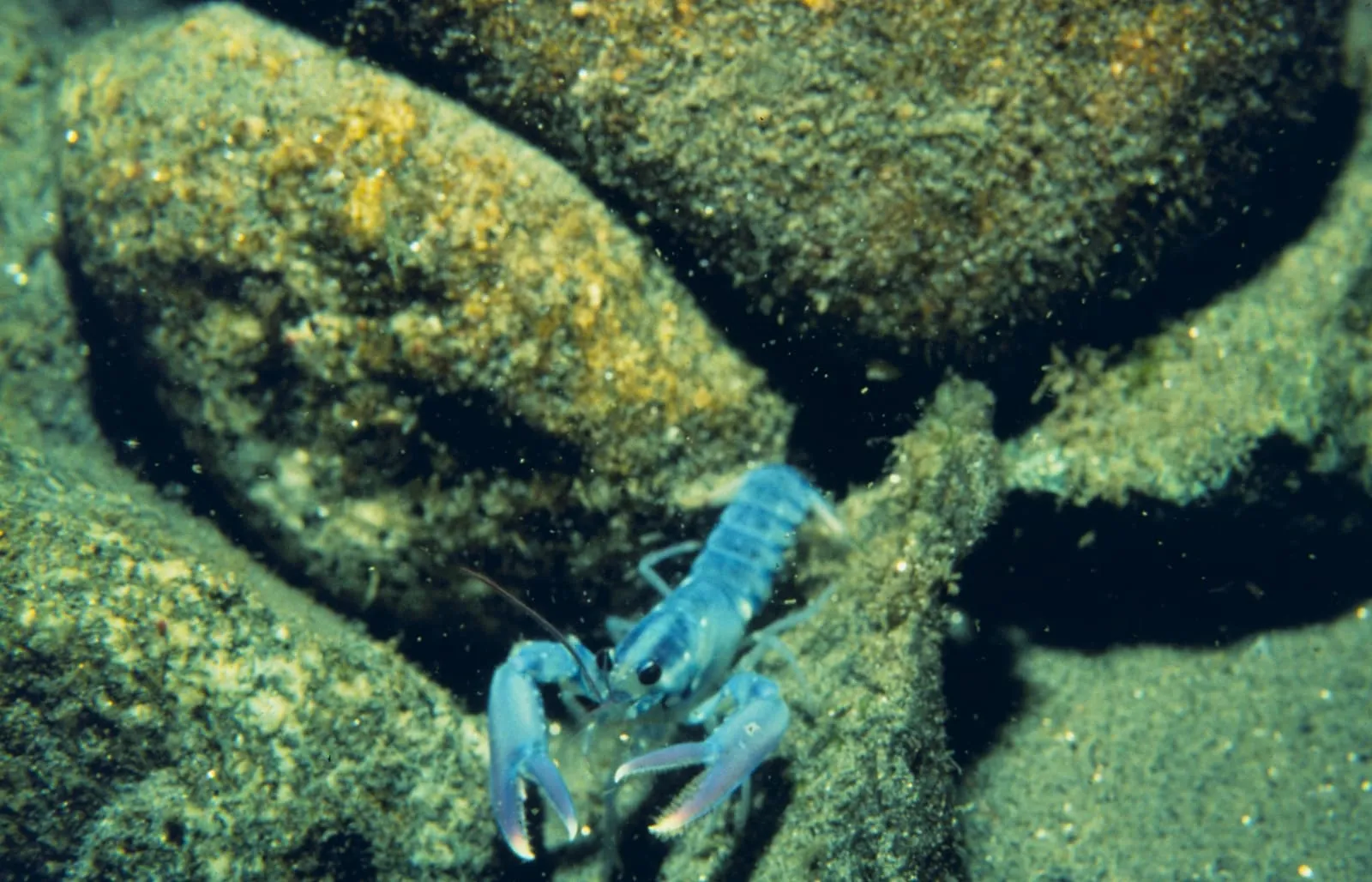
Photo: Rick Wahle via Wikimedia Commons, CC BY 2.0. A juvenile lobster in cobble habitat in Rhode Island’s Narragansett Bay. This one has an unusual blue tint; read more in blue, yellow and split lobsters.

The juvenile years: hiding in the rocks
Once a young lobster finds a crevice, it stays put. DFO says lobsters remain in or near their shelter for their first three to four years to avoid predators such as sculpins, cunners, skates and crabs. At first they feed on small organisms in and around the shelter, including amphipods, small crabs and shellfish spat, and they may even filter plankton from the water.
As they grow, they spend more time outside the shelter, start foraging farther afield and move onto more varied bottoms, including open mud and sand. Young lobsters moult often: several times a year at first, slowing as they get bigger.
When do lobsters become adults?
DFO’s 2011 publication says lobsters reach adulthood within five to seven years, depending on water temperature. The range across Nova Scotia is wide:
- Warm water, early maturity. DFO’s 1988 booklet said Northumberland Strait females may mature at about 200 g, or three years old.
- Cold water, late maturity. The same booklet said Bay of Fundy females may not mature until about 700 g, or eight years old.
- Eastern Cape Breton. A study summarized by DFO in 2013 estimated the size at which half of females are mature at 71.5 to 75.8 mm carapace length at sites in eastern Cape Breton, lowest near Dingwall in LFA 27.
Those differences explain a lot about how each fishing area is managed. In a 2020 assessment, DFO noted that in LFAs 27 to 32 the minimum legal size is above the size of maturity, so most females caught have had a chance to breed first. In LFA 33 and other inshore fisheries, the median size in the catch is below the size of maturity, so a smaller share have bred. That’s why measures such as the minimum legal size and protections for egg-bearing females matter so much, and why the map of Nova Scotia’s lobster fishing areas has different rules in different places.
And then? The adult years
Adult lobsters live mostly alone in shelters and come out after sunset to feed. They keep moulting and growing, though less and less often. Females continue their two-year breeding cycle, and the biggest females, which can carry the most eggs, become especially valuable to the population.
How long can the cycle keep turning? DFO believes the maximum age is in the range of 50 years, though no one can yet age a lobster precisely. Read more in how long do lobsters live, or explore our lobster biology topic page.
Frequently asked questions
How do lobsters reproduce?
A mature female usually mates in late summer right after she moults, while her shell is soft. The male passes a sperm packet that she stores. About a year later she extrudes her eggs, fertilizes them with the stored sperm and glues them under her tail, where she carries them for roughly 9 to 12 months until they hatch.
How many eggs does a lobster carry?
It depends on her size. NOAA gives a range of about 5,000 to more than 100,000 eggs. A 1988 DFO publication cites about 7,500 eggs for a 78 mm female, about 30,000 for a typical large Bay of Fundy breeder and more than 40,000 for jumbos over 125 mm.
How long do lobster larvae drift in the plankton?
DFO says lobster larvae spend roughly 4 to 6 weeks mostly in surface waters, moving through three larval stages and a postlarval stage. Warm water speeds this up and cold water slows it down.
What does a baby lobster look like?
Newly hatched larvae are tiny, transparent and shaped more like shrimp. By the postlarval stage (Stage IV) a baby lobster looks like a miniature adult, about 15 mm long when it settles to the bottom, and it spends its first few years hiding in rocky shelter.
How old is a lobster when it can reproduce?
It varies with water temperature. DFO says lobsters reach adulthood within five to seven years. In warm parts of the southern Gulf of St. Lawrence females can mature younger and smaller, while in the cold Bay of Fundy they mature later and larger.
Sources
We check facts against primary sources wherever possible. Season dates and regulations can change, so confirm with Fisheries and Oceans Canada before you rely on them.
- A Lobster's life on the bottom — Fisheries and Oceans Canada, 2011
- Lobster Fishing Areas 27 – 38: Integrated Fisheries Management Plan — Fisheries and Oceans Canada, 2022
- Assessment of lobster (Homarus americanus) off southwest Nova Scotia and in the Bay of Fundy (LFAs 34-38), Research Document 2013/078 — Fisheries and Oceans Canada, Canadian Science Advisory Secretariat, 2013
- Underwater World: The Lobster — Fisheries and Oceans Canada, 1988
- Assessment of Lobster (Homarus americanus) in Lobster Fishing Area 33 for 2018, Science Advisory Report 2020/002 — Fisheries and Oceans Canada, Canadian Science Advisory Secretariat, 2020
- American Lobster species profile — NOAA Fisheries
- Atlantic Fishery Regulations, 1985 (SOR/86-21) — Justice Laws Website, Government of Canada
Image credits
- Header photo: Photo: National Oceanic and Atmospheric Administration (NOAA) via Wikimedia Commons · Public domain (cropped and resized)
- A small juvenile lobster with a bluish tint peering out from a gap between cobblestones on the sea floor: Photo: Rick Wahle via Wikimedia Commons · CC BY 2.0 (cropped and resized)
lobster life cyclelobster larvaebaby lobsterlobster reproductionberried lobsterlobster eggs