Blue, Yellow and Split Lobsters: How Rare Is a Blue Lobster?
How rare is a blue lobster? The 1-in-2-million odds are guesses. Here's what makes lobsters blue, yellow, calico or split, and what Nova Scotia fishers do.
By NovaShell Editorial Team · · 7 min read
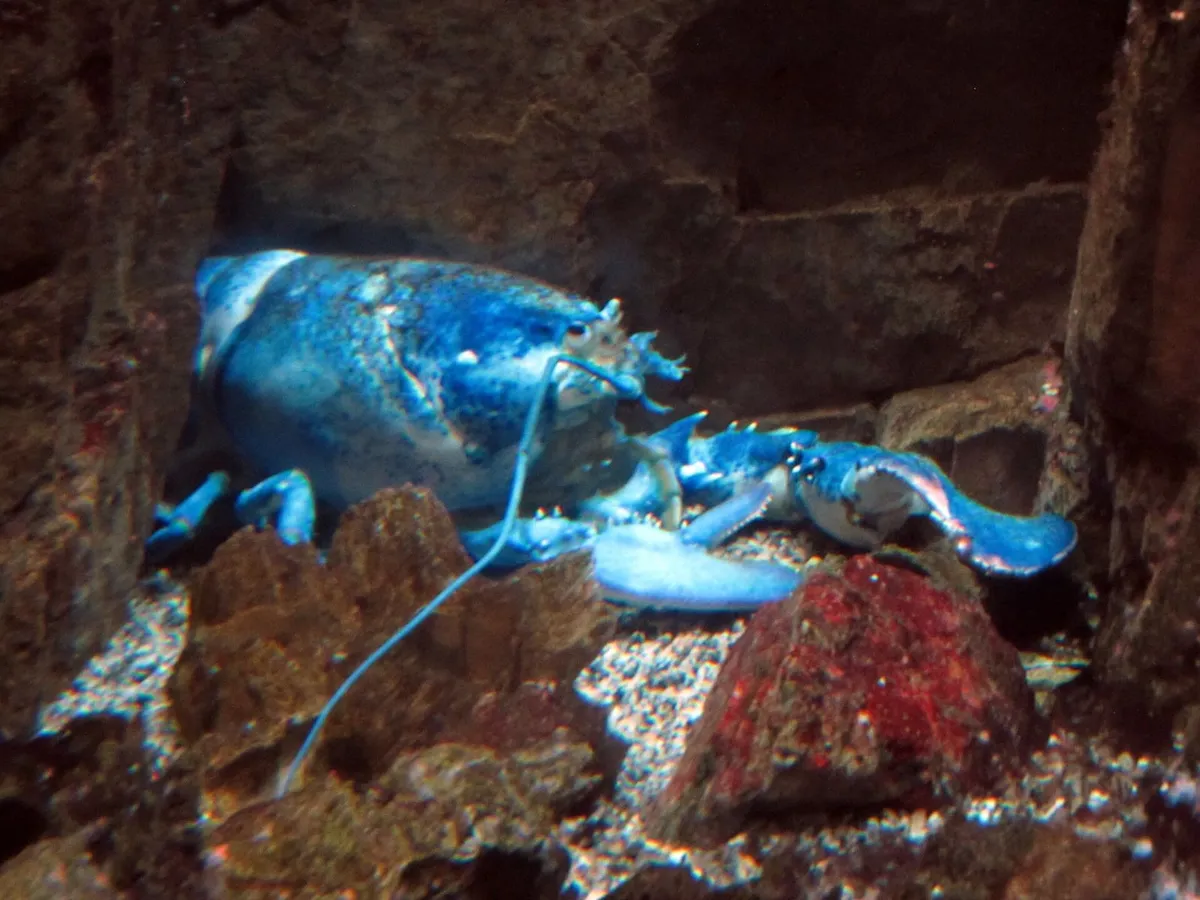
A blue lobster is a normal American lobster with a genetic quirk that shifts its shell pigment toward blue. You’ll often read that the odds of catching one are 1 in 2 million, but even the scientists who quote that number call it an educated guess. Blue lobsters do turn up off Nova Scotia every few years, and most get a ticket back to the sea rather than a trip to the pot.
Yellow, orange, calico, split-coloured and white lobsters are rarer still, at least by the usual estimates. Here’s what’s behind each colour, how much weight to put on those famous odds, and what Nova Scotia fishers actually do when one comes up in a trap. For more on the species itself, start with our guide to American lobster facts.
Why are lobsters the colour they are?
A normal live lobster is a mottled greenish-brown, not red. The colour comes from astaxanthin, a red-orange carotenoid pigment that lobsters get from their diet.
The trick is what happens to that pigment in the shell. In a 2002 paper in PNAS, Cianci and colleagues showed that when astaxanthin is bound inside a protein complex called crustacyanin, its colour shifts from orange-red to slate blue. Free astaxanthin is the orange-red you know from a cooked lobster; protein-bound astaxanthin is blue.
Michael Tlusty, who spent 20 years doing lobster research at the New England Aquarium, explained the layering to National Geographic in 2018. Proteins in the shell “grab it and twist it, and it actually turns blue,” he said, while proteins in the outermost layer bend it again and turn it yellow. Stack red, blue and yellow and you get the muddy brown of a wild lobster.
That also explains cooking. Heat denatures the proteins, they let go of the pigment, and it snaps back to red.
How rare is a blue lobster, and the other colours?
These are the odds you’ll see repeated in almost every news story, as listed by the Associated Press in 2012:
| Colour | Often-quoted odds | What’s going on |
|---|---|---|
| Blue | 1 in 2 million | Genetic variant, thought to involve extra pigment-binding protein |
| Orange | 1 in 10 million | Genetic variant |
| Yellow | 1 in 30 million | Genetic variant |
| Calico (orange-and-black or spotted) | 1 in 30 million | Genetic variant |
| Split-coloured (two colours, divided down the middle) | 1 in 50 million | Thought to arise very early in embryo development |
| White (“albino”) | 1 in 100 million | Little or no pigment; genetics or a pigment-poor diet |
Treat every number in that table as a ballpark. The 2012 AP report itself said “those are merely guesses, and nobody knows for sure.” When the Boston Globe asked in 2017, Lobster Institute director Robert Bayer said, “It’s an educated guess,” and Diane Cowan of The Lobster Conservancy pointed out that “we don’t even know how many lobsters are out there.”
The Globe also ran the numbers the other way. With roughly 250 million lobsters landed each year in the U.S. and Canada combined at the time, a 1-in-30-million colour should show up about eight times a year. The New England Aquarium’s spokesperson said they weren’t seeing that many yellows, but called the estimates “reasonable” for most colours. Read the Globe’s analysis for the full back-and-forth.
Are rare colours becoming more common? Nobody knows. Scientists quoted in both stories pointed to simpler explanations for all the headlines: far more lobsters are being caught than a few decades ago, and phone cameras and social media mean every odd lobster now makes the news.
What makes a lobster blue, yellow, calico or white?
Blue lobsters
Blue lobsters carry a genetic variant. CBC’s 2024 report described it as a mutation that causes the lobster to produce an excessive amount of a particular protein, which fits the crustacyanin chemistry above. Bayer told the Globe: “It’s a genetic variant. The best analogy is eye color in people.”
Diet can also nudge colour. In Tlusty’s lab, young lobsters raised on cheap, astaxanthin-free food grew up healthy but “ghost white.” Wild blue lobsters, though, are generally attributed to genetics.
Yellow, orange and calico lobsters
These are also usually described as genetic variants affecting how pigment is bound in the shell. National Geographic notes that such mutations “can produce some crazy colorings—brilliant blue or yellow lobsters, speckled calicos, or even two-toned split lobsters.” The orange ones cause the most double-takes: a Massachusetts seafood shop worker in 2012 thought a shipment of bright orange lobsters had arrived cooked and dead, until one crawled up his arm.
Split-coloured lobsters
A split lobster looks like two animals stitched together, often half blue and half orange or half brown. Scientists at New Hampshire’s Seacoast Science Center told WHDH in 2021 that the pattern “is suspected to be the result of a cellular split during the embryonic development of the lobster, just after fertilization.” Some split lobsters are also gynandromorphs, with male characteristics on one side and female on the other, but the exact mechanism is still not pinned down.
White and “cotton candy” lobsters
White lobsters lack pigment, either from genetics or from a diet low in astaxanthin. A pale, pastel “cotton candy” lobster caught off Grand Manan, New Brunswick, in 2017 was likely low in pigment, Tlusty told National Geographic, possibly from a bait-heavy diet or possibly a mutation. If diet was the cause, he said, eating pigment-rich food could darken it at its next moult.
Do blue lobsters turn red when you cook them?
Yes. According to the Lobster Institute’s Bob Bayer, quoted by the AP in 2012, odd-coloured lobsters “all turn red when they’re cooked, except for the white ones since they don’t have any pigment.” He added, “There’s no difference in taste.” Read the AP story.
Most people never get to test that, because most rare lobsters aren’t eaten. If you want the ordinary red kind, our guide to cooking lobster the Nova Scotia way has you covered.
Blue lobsters caught in Nova Scotia
Nova Scotia’s fleets land a lot of lobster, so rare colours appear here regularly. A few reported examples:
- Little River, Cape Breton, June 2024. Fourteen-year-old Finley Campbell was on his grandfather’s boat off Little River, south of Ingonish, when a bright blue lobster came up in a trap. CBC reported that in 50 years of fishing, his grandfather had never seen a blue one, though he’d seen white, gold and purple lobsters. They released it. “Obviously he’s a rare one, but we wouldn’t keep them. Too rare for us to keep,” Campbell told CBC.
- Sydney Mines, May 2016. Scott MacKinnon and Sonya Weiss hauled a blue lobster they named Opal, white and blue with purple edges. MacKinnon, with 30 years of fishing behind him, said it was his first. It was the second blue lobster caught off Cape Breton that weekend; the other, nicknamed Blueberry, was under the 82.5 mm legal size and had already been released. The couple kept Opal in a fisheries pound for the rest of the season, planning to return it to the ocean in July.
- Pictou, spring 2019. The Northumberland Fisheries Museum took in a split lobster that season, along with four calicoes, two bright orange lobsters and four blues, according to The Weather Network. The museum said the coloured lobsters would be released at the end of the summer.
Notice the counts. Four blue lobsters in one season at one Pictou museum is a reminder that “1 in 2 million” is not a precise rate.
What do fishers do with a rare-coloured lobster?
Colour doesn’t change the rules. A blue lobster under the minimum legal size, or a female carrying eggs, has to go back like any other. Our guide to Nova Scotia lobster regulations and the explainer on how lobsters are measured cover those rules, and V-notching explains how fishers mark and protect breeding females.
For legal-sized rare lobsters, the usual choices are:
- Release it. Many Nova Scotia crews do. In the Opal story, MacKinnon said, “The blue lobster, the old people say, my dad says, brings luck and prosperity to the boat and the crew and that it’s good luck to return it to the sea.”
- Donate it. Aquariums, science centres and museums often take rare lobsters for display. The 2017 Grand Manan cotton candy lobster went to the Huntsman Marine Science Centre in St. Andrews, New Brunswick.
- Hold it, then let it go. Opal’s owners kept it in a pound so that nobody else would catch it during the season, then planned to release it.
There may be a biological case for letting them go, too. Cowan told the AP in 2012 that odd-coloured lobsters stick out on the sea floor and are more vulnerable to predators, though fewer cod today may give them better odds than in the past.
Want more oddities from under the water? Read how long lobsters live, or browse our lobster biology topic page.
Frequently asked questions
How rare is a blue lobster?
Blue lobsters are often said to be 1 in 2 million, but that figure is an educated guess, not a measured rate. Nobody has counted the wild lobster population, and so many lobsters are landed each year that blue ones turn up in Nova Scotia fairly regularly.
What makes a lobster blue?
Lobster shell colour comes from a pigment called astaxanthin. When proteins called crustacyanins bind and twist it, it looks blue. Blue lobsters carry a genetic variant that is thought to leave more of the pigment in that blue, protein-bound form.
Do blue lobsters turn red when cooked?
Yes. Cooking breaks down the proteins holding the pigment, so blue, yellow and calico lobsters all turn red. White or albino lobsters are the exception because they lack the pigment. University of Maine's Lobster Institute says they taste the same as any other lobster.
What is the rarest lobster colour?
White (often called albino) lobsters are usually listed as the rarest, at an estimated 1 in 100 million, followed by split-coloured lobsters at about 1 in 50 million. These odds are rough estimates.
What should you do if you catch a blue lobster in Nova Scotia?
The usual rules still apply: undersized and egg-bearing lobsters must go back. Beyond that, many Nova Scotia fishers release rare-coloured lobsters for luck or donate them to aquariums and museums.
Sources
We check facts against primary sources wherever possible. Season dates and regulations can change, so confirm with Fisheries and Oceans Canada before you rely on them.
- The molecular basis of the coloration mechanism in lobster shell: β-crustacyanin at 3.2-Å resolution (Cianci et al.) — Proceedings of the National Academy of Sciences (via PubMed Central), 2002
- Why This Rare Lobster Is Colored Like Blue Cotton Candy — National Geographic, 2018-06-19
- Rare-colored lobsters keep turning up. Is something fishy going on? — The Boston Globe, 2017-09-02
- Odd-colored lobsters baffle scientists, fisherman — The Christian Science Monitor (Associated Press), 2012-07-23
- 'Too rare for us to keep': Cobalt blue lobster found off Nova Scotia — CBC News, 2024-06-25
- Unusual blue Cape Breton lobster called 'flawless' and named Opal — CBC News, 2016-05-24
- 1-in-50 million lobster found in Nova Scotia — The Weather Network, 2019-06-25
- 1-in-50 million find! Split-colored lobster on display at museum in New Hampshire — WHDH 7News, 2021-10-08
Image credits
- Header photo: Photo: daryl_mitchell via Wikimedia Commons · CC BY-SA 2.0 (cropped and resized)
blue lobsterrare lobsterslobster colourcalico lobstersplit lobsteralbino lobsterCape Breton