What Is V-Notching? How Fishers Protect Breeding Lobsters
A v-notch lobster is a female marked with a small V cut in her tail flipper so she can't be kept. How notching works and where it's required in Nova Scotia.
By NovaShell Editorial Team · · 6 min read
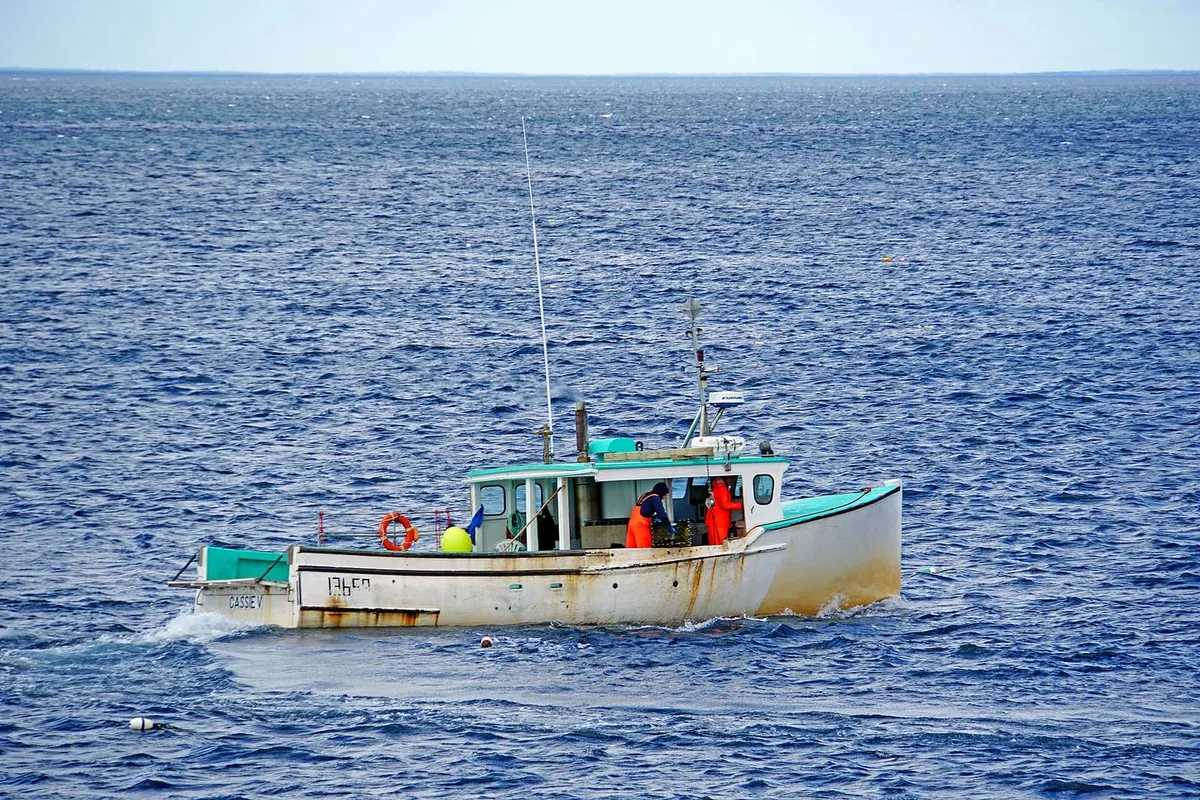
A v-notch lobster is a female that has been marked with a small V-shaped cut in one of her tail flippers, usually after she was caught carrying eggs. The notch tells every fisher who catches her later that she is a proven breeder who must go back in the water, even after her eggs have hatched. In most Nova Scotia fishing areas it’s illegal to keep a v-notched lobster, and in LFAs 31B and 32 on the Eastern Shore, notching is mandatory.
V-notching sits alongside minimum sizes, closed seasons and the release of egg-bearing females in the conservation toolkit described in our guide to Nova Scotia lobster regulations. Here’s how it works, why it matters, and what the rules are area by area.
What is a v-notch?
A lobster’s tail ends in a fan of five flat pieces: a central one and two flippers on each side. A v-notch is a small V-shaped piece cut from the edge of one of those flippers.
Fisheries and Oceans Canada (DFO) described it in a 2010 news release as “a small notch cut into the tail of a lobster to indicate that it has recently been observed bearing eggs.” In the United States, NOAA Fisheries defines the spot precisely: “a v-shaped cut out of the base of a female lobster’s tail flipper,” on the flipper “next to and to the right of the center tail flipper.” The Canadian documents we reviewed don’t name a specific flipper.
The notch doesn’t mark the lobster forever. Lobsters grow by shedding their shells, and each new shell partly fills the gap. More on that below, and in our article on lobster molting.
Why v-notch lobsters? Protecting proven breeders
Minimum sizes protect young lobsters, but a female who has already produced eggs is valuable in a different way: she has proved she can breed, and she can do it again. Berried (egg-carrying) females are already protected by law. The catch is that a female only carries eggs for part of her life. DFO says females usually spawn every second year, so in the off year she looks like any other legal lobster.
V-notching closes that gap. A fisher who hauls up a berried female notches her tail before putting her back. When she turns up in a trap a year later without eggs, the notch still marks her as off-limits.
DFO science has credited the approach. The 2020 assessment of LFA 33 noted that measures adopted in other areas since the late 1990s and early 2000s, “including increasing MLS, protecting window-sized Lobster, returning large females, and v-notching programs, have increased reproductive potential and productivity in respective LFAs.”
How v-notching works on the boat
Notching happens during the normal sorting of each trap’s catch:
- Sort out the females. Every lobster in the trap is checked, and the females get a closer look.
- Look for eggs. A berried female carries her eggs glued under her tail. She must be released.
- Notch before release. Where notching is practised, the fisher cuts the V into the tail flipper and puts her back over the side.
- Look for old notches. Any female hauled up with a notch from an earlier season is also released where the possession rule applies.
The release itself is quick. DFO’s 2022 management plan says discarded lobsters “are generally expected to survive” and calls the release of undersized, berried and v-notched females “an important conservation measure in the fishery.” For what happens to the rest of the catch, see how lobsters are caught in Nova Scotia, and for the escape vents that let small lobsters out before the trap even surfaces, our lobster trap anatomy guide.
Where is v-notching mandatory in Nova Scotia?
V-notching in Nova Scotia comes in two forms: programs that require fishers to notch females, and rules that forbid keeping a lobster that already carries a notch.
| Area | V-notching rule | Source |
|---|---|---|
| LFAs 31B and 32 (Eastern Shore) | Mandatory v-notching (2026). As of 2016, the measure was listed as “V-notching and release of 110 lb of mature females/licence.” | DFO 2026 notice; DFO Science Response 2017/026 |
| All Maritimes inshore LFAs except 27 and 31A | Possession of v-notched lobsters restricted | DFO 2022 management plan |
| Bay of Fundy LFAs 35–38 | Landing V-notched females “with no setal hairs” is prohibited | DFO Science Response 2017/022 |
| LFA 27 (Cape Breton) and LFA 31A (Guysborough County) | No possession restriction listed | DFO 2022 management plan |
DFO’s 2026 notice for LFAs 27 to 32 lists “mandatory v-notching” for LFAs 31B and 32 only. The 2017 stock update for LFAs 27–33 gave more detail on what that meant at the time: notching plus the release of 110 lb of mature females per licence.
LFAs 27 and 31A, the two exceptions to the possession rule, use other ways of protecting breeders. LFA 27 raised its minimum size sharply, and LFA 31A protects females from 114 to 124 mm carapace length with a closed window. For how size limits do this work, see our guide to the lobster minimum legal size.
The Gulf of St. Lawrence side of Nova Scotia is managed by DFO’s Gulf Region, and its 2026 plan for LFAs 26A and 26B doesn’t list a v-notch measure. Those areas rely on minimum sizes and, in 26A, a female window. To see where each area lies, use our map guide to the Nova Scotia Lobster Fishing Areas.
Voluntary notching: how it started
The current rules grew out of a push in the late 1990s. According to DFO’s 2022 plan, the Fisheries Resource Conservation Council’s 1995 report, A Conservation Framework for Atlantic Lobster, found that good egg production was key to a healthy fishery. In 1997 the federal minister set a target of doubling eggs per recruit, and fishers had from 1998 to 2001 to put measures in place.
The changes made in the Maritimes during that period included small increases in minimum size, a maximum size for females in LFA 30, the window in LFA 31A, and “adoption of a voluntary v-notching program by harvesters in all LFAs except LFA 31A and LFA 27.” DFO’s own review found the changes were mostly modest and generally fell short of the doubling target. A second council report in 2007 again named low egg production as a key risk, and DFO responded with more protection for mature females in each area.
Notched lobster rules: what about “setal hairs”?
The Bay of Fundy wording raises an obvious question: what happens as a notch heals?
A notch fills in as the lobster moults. A US tank study, DeAngelis and colleagues (2010), tracked notched lobsters over two years:
- After one moult, every lobster still had a notch deeper than 3.18 mm (⅛ inch), though most were shallower than 6.35 mm (¼ inch).
- After two moults, every notch was shallower than 6.35 mm.
- 84% of the lobsters showed setal hairs (fine bristles) growing in the notch, which the authors describe as a sign that the notch is being repaired.
- V-notching “did not have a significant negative impact on survival or disease susceptibility.”
So a protected notch is a temporary mark that lasts a few years. That’s one reason rules define a notch by its depth or by whether it has started to heal. Fishers in each area should follow DFO’s current licence conditions on exactly what counts as a notched lobster.
Does v-notching work?
DFO’s view is that v-notching is one part of a set of measures that work together. The 2020 LFA 33 assessment credits notching programs, along with bigger minimum sizes, windows and the release of large females, with increasing reproductive potential where they were used. Measuring each measure’s effect separately is harder. The same report says some effects “can be detected in some of the biological indicator trends,” and that these measures “buffer the impacts of years with suboptimal environmental conditions.”
V-notching depends heavily on fishers. It only works if they notch berried females consistently and release notched lobsters even when prices are high. That’s why it became mandatory in some areas instead of staying voluntary everywhere. For more on the biology behind all this, see American lobster facts, or browse our other rules and sustainability articles.
Frequently asked questions
What does a v-notch on a lobster mean?
It means a fisher found that female carrying eggs and cut a small V-shaped notch in one of her tail flippers before releasing her. The notch marks her as a proven breeder so that she is released again if she is caught later, even when she is no longer carrying eggs.
Can you keep a v-notched lobster in Nova Scotia?
In most areas, no. Fisheries and Oceans Canada restricts possession of v-notched lobsters in all Maritimes inshore Lobster Fishing Areas except LFA 27 and LFA 31A. Check the current DFO rules for the area where you fish or buy.
Where is v-notching mandatory in Nova Scotia?
DFO's 2026 notice lists mandatory v-notching in LFAs 31B and 32 on the Eastern Shore. Elsewhere, notching has been done under voluntary programs that harvesters adopted around 1998 to 2001.
Does v-notching hurt the lobster?
A two-year tank study published in 2010 found that v-notching did not have a significant negative effect on survival or disease susceptibility in American lobsters. The notch slowly fills in over later moults.
Sources
We check facts against primary sources wherever possible. Season dates and regulations can change, so confirm with Fisheries and Oceans Canada before you rely on them.
- Lobster Fishing Areas 27–38: Integrated Fisheries Management Plan — Fisheries and Oceans Canada, 2022
- 2026 Lobster Fishing Areas 27-32 (Maritimes Region) — Fisheries and Oceans Canada, 2026
- Lobster off the Atlantic Coast of Nova Scotia (LFAs 27-33): 2017 Stock Status Update, Science Response 2017/026 — Fisheries and Oceans Canada, Canadian Science Advisory Secretariat, 2017
- 2016 Stock Status Update of Lobster in the Bay of Fundy (LFAs 35-38), Science Response 2017/022 — Fisheries and Oceans Canada, Canadian Science Advisory Secretariat, 2017
- Assessment of Lobster (Homarus americanus) in Lobster Fishing Area 33 for 2018, Science Advisory Report 2020/002 — Fisheries and Oceans Canada, Canadian Science Advisory Secretariat, 2020
- DFO advises lobster industry to follow rules, think ahead to avoid lobster shipping holdups — Fisheries and Oceans Canada (news release, archived), 2010
- American Lobster species profile — NOAA Fisheries, 2026
- Impacts of V-Notching the American Lobster (DeAngelis et al., Journal of Shellfish Research 29(2)) — BioOne, 2010
Image credits
- Header photo: Photo: Dennis G. Jarvis via Wikimedia Commons · CC BY-SA 2.0 (cropped and resized)
v-notchingberried femalesLFA 31BLFA 32Bay of Fundyconservation