Anatomy of a Lobster Trap: Kitchen, Parlour and Escape Vents
How does a lobster trap work? A part-by-part look at the Nova Scotia lobster trap: heads, kitchen, parlour, escape vents, biodegradable panels, tags and buoys.
By NovaShell Editorial Team · · 8 min read
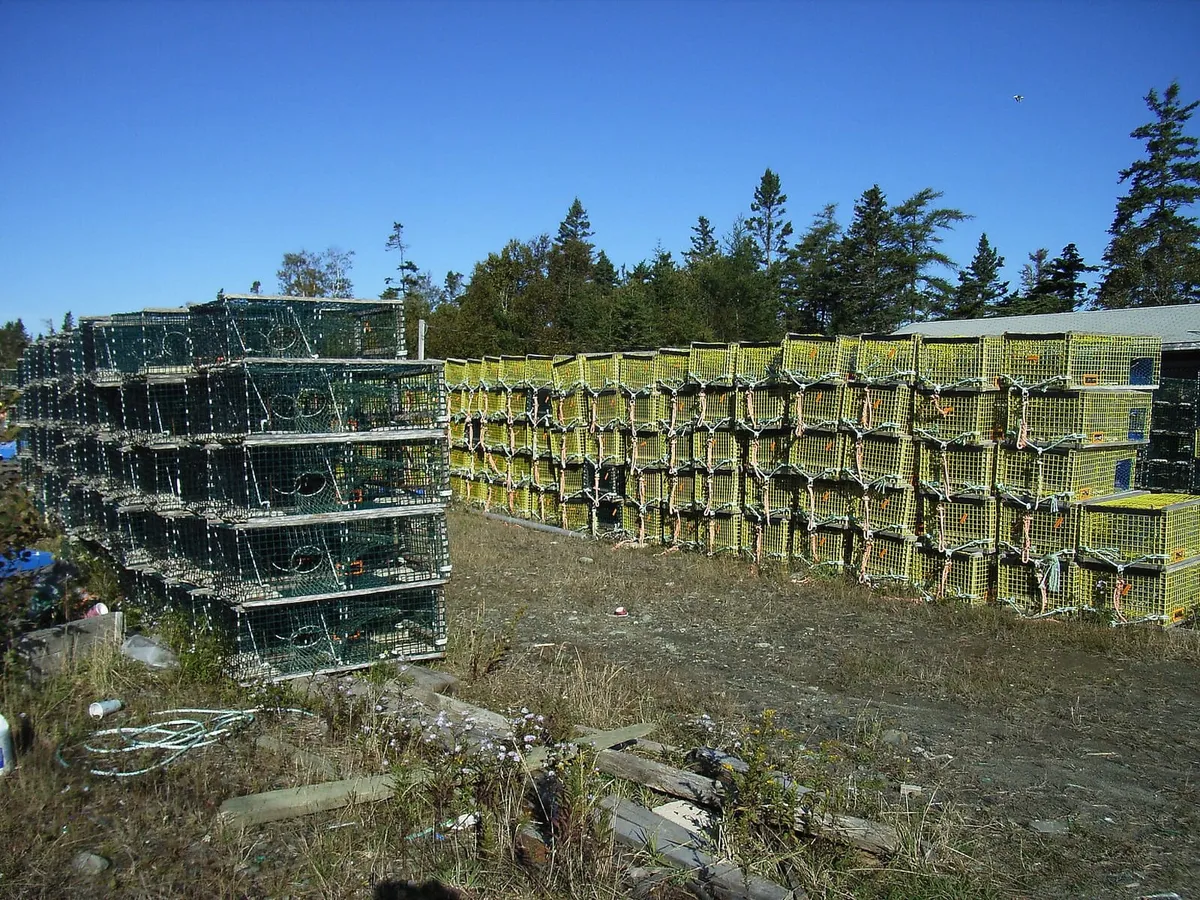
A lobster trap is a weighted, rectangular cage with a bait chamber called the kitchen and a holding chamber called the parlour. Lobsters crawl in through funnels to reach the bait, then wander into the parlour, which is easy to enter and hard to leave. Escape vents let undersized lobsters out, and a biodegradable panel makes sure a lost trap stops fishing.
Every part of the trap does a job, and many of those parts are set by law. Below is a piece-by-piece tour of the Nova Scotia lobster trap (or lobster pot, as New Englanders tend to say), plus the rules behind it. For how traps are set, hauled and emptied at sea, read how lobsters are caught, and for the wider industry see our complete guide to Nova Scotia lobster.
Lobster trap parts at a glance
| Part | What it does | Rule or note |
|---|---|---|
| Frame and mesh | Holds the shape; wire mesh or wooden laths | Max 125 × 90 × 50 cm outside LFA 41 |
| Ballast | Keeps the trap on the bottom | DFO: traps are weighted to restrict movement |
| Heads | Funnels that let lobsters in | Max entrance hoop 153 mm in LFAs 28 and 29 |
| Kitchen | Bait chamber | Bait bag or spike hangs here |
| Parlour | Holding chamber | Escape vent required in each parlour’s outer wall |
| Escape vent | Lets undersized lobsters out | Height tied to minimum legal size |
| Biodegradable panel | Opens if the trap is lost | Opening at least 89 × 152 mm |
| Trap tag | Proves the trap is licensed | Yearly numbered tags matching the trap limit |
| Rope and buoy | Marks the trap or trawl at the surface | Gear marking required in Atlantic Canada |
How does a lobster trap work?
A lobster trap works like a one-way maze. The Pictou-Antigonish Regional Library’s history of the North Shore fishery describes the traditional trap as having “two main sections, the kitchen and the parlor,” with entrances “shaped in such a way that it is easy for the lobsters to get in but difficult for them to get out.”
Here is the path a lobster takes:
- It smells the bait. Scent drifts from the kitchen on the current.
- It climbs through a head. Each head is a funnel that narrows to an entrance hoop, and the lobster drops through it into the kitchen.
- It feeds, then tries to leave. Lobsters looking for a way out tend to move through a second funnel that leads deeper into the trap.
- It ends up in the parlour. From there, getting back out through the narrow funnel is unlikely.
- Small lobsters escape. Shorts slip out through the escape vent in the parlour wall. Legal-size lobsters stay put until the trap is hauled.
A Globe and Mail reporter who spent a morning on an Eastern Shore boat in 2014 summed it up: a trap “is easy to get into but almost impossible to get out of.”
The kitchen and the bait
The kitchen is the front chamber where the bait hangs, usually in a mesh bag or skewered on a spike. On the boat in the Globe and Mail report, the deckhand rebaited with “redfish heads or mackerel or gaspereau or occasionally a sculpin on a spike” before each trap went back over. Bait choice is its own science, and its own expense, which we cover in a separate guide.
The parlour: where the catch waits
The parlour is the holding room. Traps can have one parlour or two, and fishers tinker with the layout. When DFO scientists interviewed fishers on Nova Scotia’s outer coast in 1998, most said they had modified their trap designs in recent years “by changing hoop sizes, numbers of entrance heads, number of parlour chambers, etc.”
What doesn’t change is the rule that matters most to the lobster: Fisheries and Oceans Canada (DFO) requires that “all traps must be fitted with escape vents in the exterior wall of each parlour.”
Escape vents: how small lobsters get out
An escape vent is a rectangular opening in the parlour wall. It is sized so that lobsters under the minimum legal size can squeeze through while legal ones can’t. DFO notes that vents also let some non-target species escape.
Vent size is tied to the minimum legal carapace length, and the exact dimensions are written into each area’s licence conditions. DFO’s Gulf Region, which manages the Northumberland Strait and western Cape Breton areas, published this table in 2022 for vents between 127 mm and 254 mm long:
| Minimum legal carapace size | Minimum vent height |
|---|---|
| Over 73 mm to 76 mm | 43 mm |
| Over 76 mm to 79 mm | 44 mm |
| 80 mm to 81 mm | 46 mm |
| Over 81 mm to 83 mm | 47 mm |
| Over 83 mm to 84 mm | 48 mm |
| Over 84 mm to 85 mm | 49 mm |
Source: DFO Gulf Region, 2022. Vents 254 mm or longer have slightly different heights at the low end.
Most of Atlantic Nova Scotia’s inshore areas have an 82.5 mm minimum size, and LFAs 28 and 29 have 84 mm. If you are checking gear for a specific area, the current licence conditions from your DFO area office are the authority. For how the carapace is measured, see our guide to lobster minimum legal size.
The biodegradable panel and ghost fishing
A trap lost to a storm, a cut line or a passing vessel keeps fishing until something stops it. DFO calls this ghost fishing: “capture due to lost, dumped or abandoned fishing gear.” The answer, required since the mid-to-late 1980s, is a biodegradable panel.
Under section 61.1 of the Atlantic Fishery Regulations, every lobster trap in LFAs 1 to 22 and 27 to 41 must have, in one exterior wall of each parlour, either:
- An escape panel that leaves an unobstructed opening at least 89 mm high and 152 mm wide, fastened with untreated cotton or sisal twine no more than 4.8 mm thick, or with uncoated, non-stainless ferrous (iron or steel) wire of 1.6 mm or less; or
- For wooden traps, two adjacent softwood laths that have not been treated with wood preservative.
Over time the twine rots, the wire rusts or the laths decay, the panel falls open and lobsters can walk out. DFO’s 2022 management plan states that “all traps in every LFA are fitted with biodegradable panels,” and lobster licence holders in every area must also report lost traps, rope and buoys.
Frame and ballast: wire vs wooden lobster traps
The library history says the classic wooden lath trap “is said to have originated in Cape Cod in 1810” and that most traps today are factory-made of metal or a mix of wood and metal. DFO’s interview studies show how fast that change came to Nova Scotia’s outer coast:
| Trap material | LFA 33, 1983 | LFA 33, 1998 | LFA 31, 1998 |
|---|---|---|---|
| Wood | 100% | 10% | 56% |
| Wire | 0% | 38% | 6% |
| Both | 0% | 52% | 38% |
Wire won on durability: the same DFO paper refers to “low maintenance wire traps.” Wood hasn’t disappeared, though. In 2014, the Globe and Mail found that most fishermen in LFA 32 still preferred wood because it is “darker” and soaks up water faster, while the captain it followed fished wire traps that cost him $118 each, plus about $30 for rope and buoy.
Either way, a trap needs weight. DFO says traps “are weighted to restrict movement caused by currents.” That keeps the footprint on the bottom small and limits dragging.
How big can a lobster trap be?
Outside the offshore LFA 41, the regulations cap any lobster trap at 125 cm long, 90 cm wide and 50 cm high. Some areas also limit the entrance hoop: DFO’s plan lists a maximum hoop of 153 mm in LFAs 28 and 29, which limits the size of lobster that can get in.
Trap tags: the trap limit you can see
Every licensed trap carries a tag. DFO issues each licence holder “a yearly set of consecutively and uniquely numbered tags to attach to their traps, which match the trap limit.” Fishery officers check compliance by looking for validly tagged traps, and a lost or destroyed trap needs a replacement tag before a new one goes in the water. Trap limits vary by area, from 250 in many inshore areas to 375 in LFA 34 for most of its season.
Rope, buoys and trawls
A trap is only useful if you can find it again.
- Buoys. Each fisher paints buoys in a distinct colour scheme, according to the library’s glossary, so crews can pick out their own gear.
- Single traps vs trawls. Some traps are fished singly, each with its own line to the surface. Others are tied into trawls, a line of traps with a buoy at each end. The glossary notes that trawls of three, five, seven and ten traps are common in the southern Gulf.
- Gear marking. DFO requires gear marking for all non-tended fixed gear in Atlantic Canada and Quebec, identifying the region, the fishery and, for lobster, the fishing area. This is part of the North Atlantic right whale measures, which also trial “whalesafe” gear with fewer vertical lines.
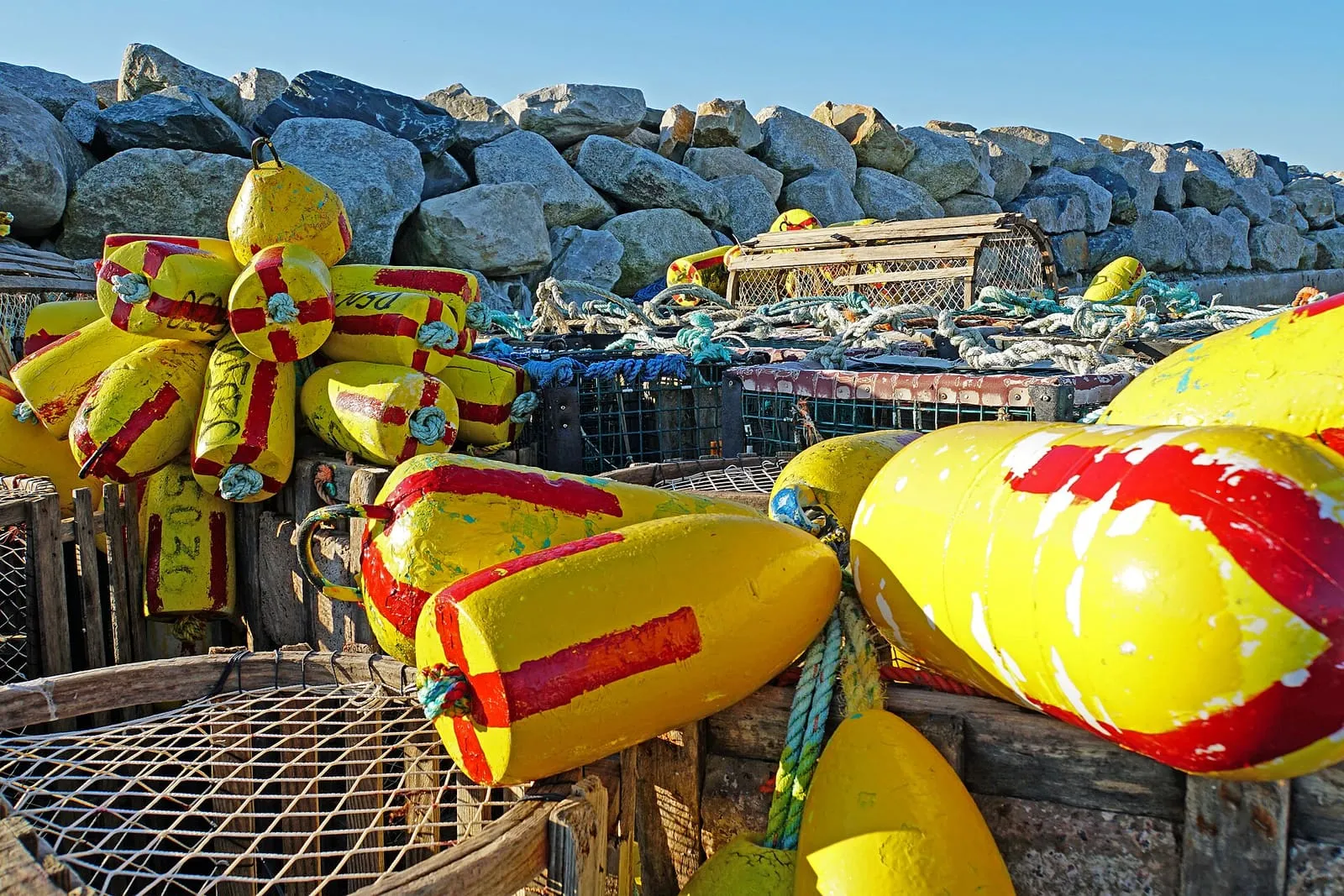
Photo: Dennis G. Jarvis via Wikimedia Commons, CC BY-SA 2.0

Why trap design matters for the lobster
Trap rules are conservation tools. DFO lists “gear fitted with escape vents and biodegradable panels” among the core measures that keep fishing mortality moderate, alongside trap limits, seasons and minimum sizes. Vents keep small lobsters growing for another moult or two; see how lobsters grow by moulting. Panels stop lost gear from killing lobsters for years. And the trap’s history, from wooden laths to wire mesh, mirrors the fishery’s own; our history of lobster in Nova Scotia tells that story. For the full rulebook, see Nova Scotia lobster regulations, or browse the lobster fishing industry hub.
Frequently asked questions
How does a lobster trap work?
A lobster crawls through a funnel called a head into the kitchen, where the bait hangs. When it tries to leave, it tends to move through a second funnel into the parlour, which is easy to enter and hard to exit. Undersized lobsters can squeeze out through escape vents in the parlour wall.
What is the difference between a lobster trap and a lobster pot?
Nothing but the word. Canadian regulations and most Nova Scotia fishers say trap; pot is the more common word in Britain and parts of New England. Both mean the same baited cage.
What is a biodegradable panel on a lobster trap?
It is a section of each parlour wall held on with untreated cotton or sisal twine, uncoated steel wire, or untreated softwood laths. If the trap is lost, the fastening rots or rusts away and opens a gap of at least 89 by 152 mm so lobsters can walk out, which limits ghost fishing.
How big can a lobster trap be in Nova Scotia?
Outside the offshore LFA 41, the Atlantic Fishery Regulations cap a lobster trap at 125 cm long, 90 cm wide and 50 cm high.
Are lobster traps made of wood or wire?
Both. Nova Scotia traps were almost all wood until the early 1980s; by 1998 most outer-coast fishers in LFA 33 used wire or a mix of wire and wood. Some areas still favour wood.
Sources
We check facts against primary sources wherever possible. Season dates and regulations can change, so confirm with Fisheries and Oceans Canada before you rely on them.
- Atlantic Fishery Regulations, 1985 (SOR/86-21), sections 61 and 61.1 — Justice Laws Website, Government of Canada
- Lobster Fishing Areas 27–38: Integrated Fisheries Management Plan — Fisheries and Oceans Canada, 2022
- New Requirements for Height and Length of Escape Mechanisms for Lobsters 80 mm and Over — Fisheries and Oceans Canada, Gulf Region, 2022
- Lobster Fishing Effort on the Outer Coast of Nova Scotia, 1983 Versus 1998 (Research Document 2002/022) — Fisheries and Oceans Canada, Canadian Science Advisory Secretariat, 2002
- Lobster in the Northumberland Strait: History — Pictou-Antigonish Regional Library
- Lobster in the Northumberland Strait: Glossary — Pictou-Antigonish Regional Library
- Cheap at sea, pricey on the plate: The voodoo of lobster economics — The Globe and Mail, 2014-07-11
- 2026 fishery management measures (North Atlantic right whale) — Fisheries and Oceans Canada
Image credits
- Header photo: Photo: Torsten Henning via Wikimedia Commons · Public domain (cropped and resized)
- A stack of yellow and red painted lobster buoys, wooden and wire lobster traps and coiled rope piled on a Nova Scotia jetty at the end of the season: Photo: Dennis G. Jarvis via Wikimedia Commons · CC BY-SA 2.0 (cropped and resized)
lobster trapslobster potescape ventsghost fishingtrap tagsfishing gear