How to Steam Lobster (With Timing Chart)
How to steam lobster at home: how much water and salt, a steaming time chart by weight from 1 to 5 lb, steam vs boil compared, and tips for big batches.
By NovaShell Editorial Team · · 7 min read
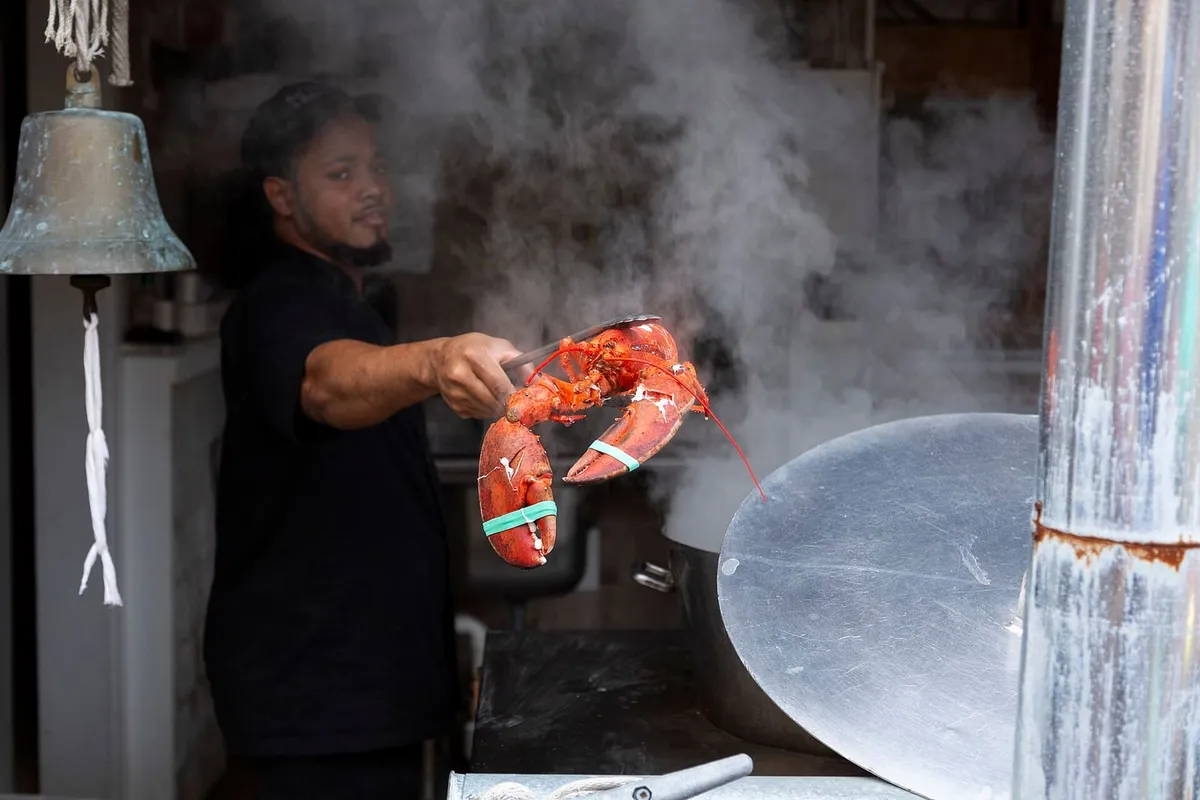
To steam lobster, bring about 2 inches (5 cm) of salted water or clean seawater to a rolling boil in a large pot fitted with a rack. Add the live lobsters, cover tightly and start timing: about 10 minutes for a 1 lb (450 g) lobster, 14 minutes for 1½ lb and 18 minutes for 2 lb. Those times come from the Maine Lobster steaming guide. Steaming takes a little longer than boiling, but it’s gentler. The industry guide says it “yields slightly more tender meat” and that “it’s harder to overcook a steamed lobster.”
This guide covers steaming in detail. For other methods, see our pillar guide on how to cook lobster the Nova Scotia way. If you’d rather use a big pot of water, our lobster boiling time chart has the boiling numbers.
Steaming lobster time chart
These are the Maine Lobster Marketing Collaborative’s steaming times. Start the clock when the lobsters are in and the lid is on. For comparison, the last column gives the same organization’s times for boiling in a full pot.
| Lobster weight | Steaming time | Boiling time (full pot) |
|---|---|---|
| 1 lb (450 g) | 10 min | 8 min |
| 1¼ lb (570 g) | 12 min | 9–10 min |
| 1½ lb (680 g) | 14 min | 11–12 min |
| 1¾ lb (790 g) | 16 min | 12–13 min |
| 2 lb (900 g) | 18 min | 15 min |
| 2½ lb (1.1 kg) | 22 min | 20 min (2¼ lb) |
| 3 lb (1.4 kg) | 25–30 min | 25 min |
| 5 lb (2.3 kg) | 40–45 min | 35–40 min |
Other good sources disagree in both directions, so check doneness rather than trusting any single number. The Lobster Council of Canada is more cautious. It steams lobsters over just ½ inch (about 1 cm) of water seasoned with a tablespoon each of salt and vinegar, for 15 minutes for a 1 lb lobster plus 5 minutes for each additional pound. America’s Test Kitchen steams 1¼ lb hard-shell lobsters for 8 to 14 minutes, until the tail reaches 60°C (140°F). Maine lobsterman Curt Brown told Saveur he steams lobsters for about 12 minutes if they’re soft-shell and 14 if they’re hard-shell. That’s for the 1 to 1½ lb lobsters he suggests cooking two at a time in a home stockpot.
Soft-shell lobsters steam faster
A soft-shell lobster has recently moulted. Its new shell is thin, and it carries more water and less meat. Brown’s two-minute difference between soft-shell and hard-shell lobsters is a useful rule of thumb. If you know you have soft-shells, check them a couple of minutes before the chart time. Our guide to hard-shell vs soft-shell lobster explains how to tell them apart at the counter.
What you need: the lobster steamer pot
You don’t need special equipment. You need:
- A large, heavy-bottomed pot with a tight lid. A canning pot, a tall stockpot or a two-piece steamer pot all work. The Maine guide says a 4- to 5-gallon (15–19 L) pot handles 6 to 8 lb of lobster. Saveur’s lobsterman suggests two 1 to 1½ lb lobsters for an average home stockpot.
- A rack or steamer insert to keep the lobsters above the water. A round cake rack, a pasta insert or even a layer of balled-up foil will do the job.
- Long tongs for adding and removing the lobsters.
- An instant-read thermometer if you want certainty. It’s optional, but it takes the guesswork out.
How much water and salt?
Use about 2 inches (5 cm) of water in the bottom of the pot. Both the Maine guide and Clearwater, the seafood company that began as a Halifax lobster shop in 1976, use this depth. America’s Test Kitchen uses about 1 inch with a wire rack. Either depth works as long as the water stays below the rack and doesn’t run dry.
Seawater is the classic choice. The Maine guide calls for “seawater or salted water.” Saveur’s lobsterman adds “a couple of tablespoons of sea salt,” or uses sea water when he’s cooking by the shore. If you collect seawater on the Nova Scotia coast, take it from clean open water, well away from wharves, outfalls and boat traffic. With tap water, those couple of tablespoons of sea salt are plenty, since the lobsters sit above the water rather than in it.
Step-by-step: how to steam lobster
- Keep the lobsters cold and alive until cooking. Leave the claw bands on. Our guide on how to store live lobster explains how to keep them lively until the pot is ready.
- Set up the pot. Put the rack in, add about 2 inches of seawater or salted water, cover and bring it to a rolling boil over high heat.
- Add the lobsters one at a time, head first, using tongs. Arrange them in a single layer if you can. If you have to stack them, put the biggest on the bottom, closest to the heat.
- Cover tightly and start timing from the chart. America’s Test Kitchen turns the heat down to medium-high once the lobsters are in, so the steam stays strong without boiling the pot dry.
- Check the water. Clearwater says to check after five minutes to make sure there’s enough left. Top up with boiling water from a kettle if needed, not cold water.
- Rotate large batches halfway through. Swap the top and bottom lobsters so they cook evenly. Work quickly and put the lid straight back on.
- Check for doneness (see below) before you pull everything out.
- Lift out with tongs and rest for a few minutes. Then serve with melted butter and lemon.
How to tell when steamed lobster is done
The Maine guide warns that a bright red shell “is not the best indicator of doneness.” Big lobsters in particular can turn red before the thickest meat is cooked. Instead:
- Crack the shell where the body meets the tail. The meat should have changed from translucent to white.
- Tug an antenna. Saveur’s lobsterman says it should come away easily when the lobster is cooked.
- Take its temperature. Measure the thickest part of the tail with an instant-read thermometer. America’s Test Kitchen stops at 60°C (140°F) for tender meat. Health Canada lists 74°C (165°F) as the safe internal temperature for shellfish and crustaceans, including lobster, and Clearwater’s instructions go to 82°C (180°F). If you’re serving young children, older adults, pregnant guests or anyone with a weakened immune system, use the Health Canada temperature.
If a lobster isn’t done, put it back in the steamer for a couple of minutes and test again.
Steam vs boil lobster: which is better?
| Steaming | Boiling | |
|---|---|---|
| Water needed | About 2 inches in the pot | A full pot, roughly 2 L of water per pound of lobster (Clearwater) |
| Time to heat the pot | Fast | Slow |
| Cooking time | A few minutes longer (10 min for 1 lb) | Shorter (8 min for 1 lb) |
| Texture | Slightly more tender, according to the Maine guide | Can turn rubbery if you overshoot |
| Margin for error | “Harder to overcook” | Smaller |
| Seasoning | Light | More, because the lobster sits in salted water |
| Crowded pot | Uneven unless you rotate | More even, because water surrounds every lobster |
| Mess | Less water to drain from the shell | Lobsters come out full of cooking water |
Choose steaming when you’re cooking a few lobsters in a home kitchen, when you want tender meat for eating out of the shell, or when you’re picking meat for a Nova Scotia lobster roll or lobster chowder. Steamed lobsters aren’t submerged, so they don’t fill up with cooking water. Picking them is less of a mess.
Choose boiling when you’re cooking a large batch at once and want every lobster to cook evenly, or when you prefer a more strongly seasoned lobster.
Steaming lobster in big batches
Steaming scales up well for a crowd, with a few adjustments:
- Don’t overcrowd. Stay within the Maine guide’s 6 to 8 lb for a 4- to 5-gallon pot. If you have more lobsters than that, use two pots or cook in rounds.
- Group lobsters by size. Clearwater recommends cooking only similarly sized lobsters together. If you must mix sizes, start the largest first and add smaller ones later so they finish together.
- Add a few minutes for a full pot. A pot packed with cold lobsters takes longer to recover. Check the slowest lobster, usually the biggest one or the one in the middle, before you call the batch done.
- Keep a kettle going so you can top up the water with boiling water during long batches.
- Hold finished lobsters warm on a sheet pan under foil while the next round steams, or serve each batch as it comes out.
Planning a party? Our guide to lobster sizes and grades explains the size names you’ll see for sale, from canners to jumbos. Once dinner is on the table, our step-by-step guide on how to eat a lobster will help any first-timers. You’ll find more in our cooking and recipes collection.
Frequently asked questions
How long do you steam a 1 lb lobster?
About 10 minutes, according to the Maine Lobster steaming chart. Start timing once the lobster is in the pot and the lid is on, then check that the meat where the tail joins the body is white rather than translucent.
How long do you steam a 2 lb lobster?
About 18 minutes. Check the thick claw meat as well as the tail, because the claws on bigger lobsters are often the last part to finish.
How much water do you need to steam lobster?
About 2 inches (5 cm) in the bottom of a large, heavy pot, ideally with a rack to keep the lobsters out of the water. Clearwater suggests checking after five minutes so the pot doesn't boil dry.
Is it better to steam or boil lobster?
Steaming takes a few minutes longer but uses far less water, comes back to temperature faster and is gentler, so the meat tends to be more tender and is harder to overcook. Boiling is faster and cooks more evenly when the pot is crowded.
Sources
We check facts against primary sources wherever possible. Season dates and regulations can change, so confirm with Fisheries and Oceans Canada before you rely on them.
- How to Steam Lobster — Maine Lobster Marketing Collaborative (Lobster from Maine)
- How to Boil Lobster — Maine Lobster Marketing Collaborative (Lobster from Maine)
- Live Lobster: cooking instructions — Clearwater
- Preparing Lobster — Lobster Council of Canada
- Steamed Whole Lobsters — America's Test Kitchen
- How To Cook a Lobster, According to a Maine Lobsterman — Saveur, 2022
- Safe internal cooking temperatures chart — Health Canada
Image credits
- Header photo: Photo: Richard Ricciardi via Wikimedia Commons · CC BY 2.0 (cropped and resized)
steamingcooking timeslive lobsterlobster potbig batches